

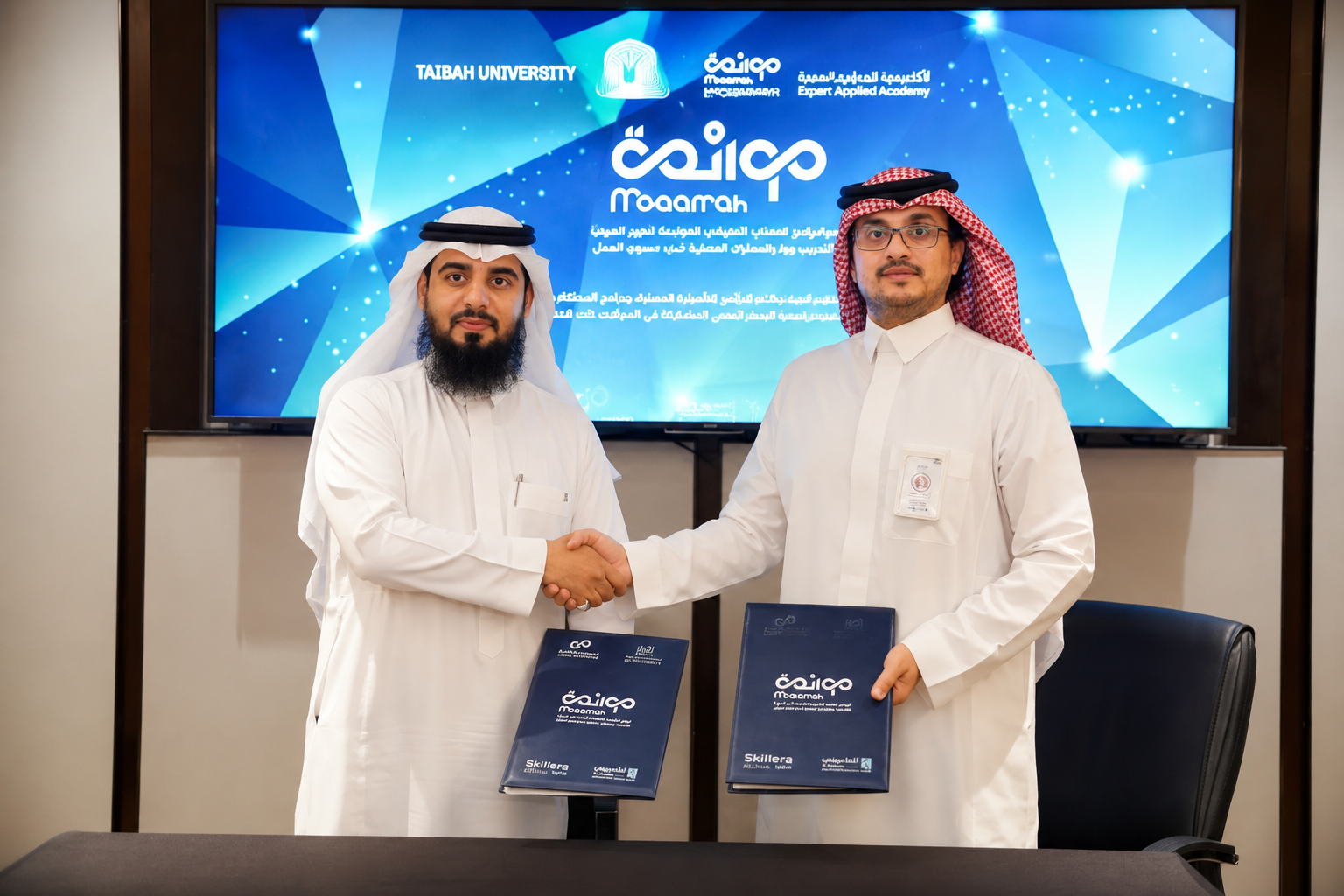
Taibah University and Mowaamah have signed a cooperation agreement aimed at strengthening the integration between academic education and professional training, enhancing students’ and graduates’ readiness for the labor market, and developing the ability of Saudi talent to apply artificial intelligence across different fields and professions.
The partnership comes as the labor market undergoes rapid transformation driven by the growing adoption of artificial intelligence technologies. This shift is increasing demand for professionals who can combine academic knowledge with practical digital and AI-related skills.
Taibah University was represented at the signing by Dr. Khaled bin Mujahid Al-Harbi, Dean of the College of Business in Yanbu, on behalf of the university president, while Mowaamah was represented by Chairman Saeed bin Saad Al-Shahrani.
Practical Training and Professional Programs
The agreement covers cooperation in developing and implementing professional qualification programs, applied training and practical simulation initiatives designed to better align academic outcomes with labor market requirements.
The partnership will also include cooperation in professional boot camps and training programs, research and innovation initiatives, as well as joint projects aimed at developing future-oriented skills and strengthening the capabilities of Saudi talent.
The approach reflects a growing emphasis on connecting academic education with the practical requirements of modern jobs. Rather than relying solely on theoretical knowledge, the partnership seeks to provide students and graduates with applicable skills that can be used directly in professional environments.
AI Applications Across Professional Fields
Alongside the signing of the agreement, Mowaamah launched a number of applied professional programs under its “Mowaamah AI Track,” focusing on the practical use of artificial intelligence across several professional disciplines.
The newly launched programs include tracks for accounting specialists, finance specialists, human resources specialists, marketing and corporate communications specialists, as well as professional administrative employees using artificial intelligence.
The programs are designed for students, graduates and employees, with a focus on applying AI tools and technologies within specific professions and workplaces. The goal is to improve productivity, enhance professional efficiency and support more effective approaches to everyday tasks.
The initiative goes beyond simply teaching participants how to use AI tools. It seeks to integrate artificial intelligence into the professional skills associated with each field, giving participants greater ability to adapt to the changing demands of the labor market.
Aligning Education with the Future of Work
The partnership between Taibah University and Mowaamah also addresses one of the key challenges facing modern labor markets: the gap between academic outcomes and the skills required for emerging jobs.
As organizations increasingly rely on digital technologies and AI for analysis, decision-making, marketing, management, human resources and financial operations, technological skills have become an increasingly important component of professional qualifications.
Against this backdrop, the joint programs are designed to help students, graduates and employees use artificial intelligence more effectively within their respective fields, while strengthening their ability to keep pace with rapid developments in the business environment.
The initiative may also support graduates as they transition from academic life into employment by giving them practical capabilities that are directly connected to the jobs and professional fields they seek to enter.
Supporting Saudi Talent Through Strategic Cooperation
The agreement forms part of a broader trend toward strengthening partnerships between educational institutions and organizations specializing in professional development and workforce training.
Such cooperation can provide students and graduates with greater exposure to real-world applications of emerging technologies, while giving them opportunities to participate in professional programs, boot camps, research initiatives and innovation projects.
The focus on artificial intelligence in fields such as accounting, finance, human resources, marketing and administration also highlights the expanding role of AI beyond traditional technology and engineering sectors.
Overall, the partnership reflects the growing importance of developing an education and training ecosystem that is closely connected to the needs of the modern economy, while equipping Saudi talent with practical, adaptable skills capable of supporting their careers in an increasingly AI-driven labor market.