


By Jamila El Mir, Wave Insights and Activation Lead
Coastal ecosystems are often described as “priceless.” In practice, that has meant they are priced at zero.
Mangroves are cleared for development, seagrass meadows are dredged for ports, and salt marshes are drained for housing. The benefits they provide, such as storm protection, carbon storage, fisheries support, and tourism, are acknowledged in principle but rarely quantified in ways that influence financial decisions and long-term planning.
“Nature is not on the balance sheet,” says Dr. Ralph Chami, Wave’s Chief Economist, who has taken it upon himself to translate ecosystem services into financial language. Until recently, he explains, conservation has been framed as a cost.
Emerging valuation methods are changing how coastal ecosystems are perceived, as assets rather than just habitats. In turn, this is creating a shift in how they are valued as investments. New tools and frameworks aim to quantify the services provided by coastal ecosystems in monetary terms, influencing how coastlines are managed, insured, and developed.
The benefits of coastal ecosystems
The economic case for coastal ecosystems is well established. Mangroves can reduce storm damage by billions of dollars each year. Seagrasses and salt marshes store vast amounts of carbon, as do mangroves. All three underpin healthy fisheries, vibrant coastal tourism, and enhanced water quality. What is not as well established is measuring these benefits systematically and holistically and presenting them in a form that investors and policymakers can interpret.
As Dr. Chami explains, valuation begins by understanding how ecosystems grow, where they are located, and how they function. “It has to be based on science,” he says. That includes the rate at which mangroves or seagrasses sequester carbon, for example, and the factors that affect that process.
From there, the exercise becomes more technical. Models estimate how ecosystems evolve over time, incorporating uncertainty and new data as it becomes available. Only then comes the financial step: assigning value using market techniques that investors recognize. “Using well known and tested market techniques is paramount for providing credible estimates that markets can believe in,” Chami says.
Those estimates report an expected value, with a degree of uncertainty attached.
Carbon as a starting point
Much of the early progress in ecosystem valuation has focused on carbon. In carbon markets, emissions are assigned a monetary value. Companies or governments that reduce or remove greenhouse gases generate credits, which can then be sold to those seeking to offset their emissions. Blue carbon markets apply that logic to coastal ecosystems, applying a financial framework to the carbon that mangroves, seagrasses, and salt marshes store. This has helped channel funding into restoration.
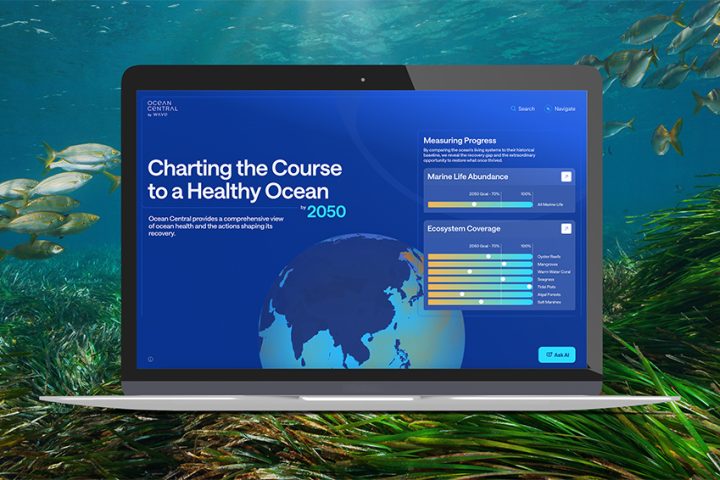
Emerging tools can help illustrate the economic value of blue carbon. Ocean Central (oceancentral.org), a data platform developed by the collective action platform Wave (thewave.global), addresses the potential for blue carbon as a nature-based solution by giving indicative valuations for carbon stock in mangroves, saltmarshes, and seagrasses based on publicly available social cost of carbon (SCC) values. These can be examined country by country and tracked over time where data is available. While these figures do not reflect real-world tradable assets, they give an indication of the value of just one aspect of the services provided by marine ecosystems and provide insight into the potential for recognizing these natural assets for the benefits they provide moving forward.
For a developer, that might mean estimating the downstream costs of clearing a salt marsh: higher insurance premiums, greater flood risk, increased spending on protective infrastructure. For a local government, it could mean weighing the cost of ecosystem and biodiversity restoration against avoided damages. For investors, it offers a way to incorporate natural assets into risk-return calculations. Stakeholders would need more detailed information than what Ocean Central provides to inform these decisions but it offers a starting point.
Beyond carbon
Carbon captures only part of the picture. “Coastal ecosystems are interconnected and interdependent systems which provide a web of benefits to humans,” says Ignace Beguin, executive director of Mangrove Breakthrough, a global initiative aiming to mobilize $4 billion to protect and restore 15 million hectares of mangroves by 2030. None of these benefits, he argues, should be considered in isolation.
Carbon, in particular, is “one critical but limited source of revenue,” he says. A broader lens encompassing infrastructure resilience, water systems, and food production can unlock a much larger pool of capital, both public and private. Fisheries supported by healthy ecosystems have market value; so does tourism, from recreational fishing to birdwatching. Even water filtration can be framed in terms of avoided treatment costs.
The difficulty in scaling private investment in coastal ecosystems lies in making these links visible to financial decision-makers. Financial institutions need to understand the materiality of coastal ecosystems to their activities and their exposure, says Beguin. In other words, what happens to an investment portfolio when nearby ecosystems degrade?
Frameworks for making these broader connections already exist. Detailed methodologies for natural capital accounting at an organization or jurisdiction level have been around for decades. The United Nations’ System of Environmental-Economic Accounting (SEEA) was first introduced in 1993 and adopted by the UN Statistical Commission in 2012 as the first global framework for valuing ecosystem services. Since then, several frameworks and standards have been introduced, including the International Organization for Standardization’s natural capital accounting standards for organizations, and the Capitals Coalition’s Natural Capital Protocol, supported by the World Wildlife Fund.
In spite of frameworks, toolkits, and standards being available and applied, the translation of these assessments into market mechanisms has been limited and slow. Individual pilot projects can be noted, and the nascent nature credit market provides signals that change is happening, but the reality is that it is mostly in the experimental phase. We have not yet succeeded in embedding it into the global trade and economic systems that govern our world and commercial transactions.
Pricing risk and protection
Practitioners often bring the value of ecosystems to life by looking at the cost of their loss. “There are many documented cases where the loss of seagrass and mangroves led to the total destruction of homes and damages to infrastructure,” says Chami. Those losses can be estimated as “value at risk.” Alternatively, they can be inferred from the cost of replacing natural protection with built infrastructure. Where mangroves have been cleared, governments often resort to seawalls, which are expensive to build and maintain. Viewed this way, a mangrove forest is a form of coastal defense, with a measurable economic value.
Tools such as the Coastal Risk Index (CRI), developed by the Ocean Risk and Resilience Action Alliance, attempt to quantify this protection. Rather than focusing on carbon, the CRI models how ecosystems reduce exposure to coastal flooding, translating ecological presence into avoided economic loss. The platform combines data on sea-level rise, tides, and storm surges to simulate extreme flood scenarios under current conditions and future climate projections and provides a comparison of the areas impacted by flooding with and without the presence of natural barriers, namely mangroves and coral reefs.
By running these scenarios with and without ecosystems in place, the model estimates how many people and how much economic value are protected by nature. In the Dominican Republic, for instance, coastal ecosystems are estimated to reduce flood damages by more than $100 million annually, with benefits projected to increase as climate risks intensify. Such estimates can reshape policy and business decisions. What was once a question of environmental protection becomes one of risk management.
A change in mindset
In order for valuation tools to inform risk management, decision-makers need credible, usable data. This is where new valuation tools can make a difference. Recent expansions in ecosystem data now allow users to explore mangroves, seagrasses, and salt marshes. Rather than attempting to capture every ecosystem service at once, these methods often begin with carbon as a baseline, while signaling that the true value is far broader. The emphasis, as Beguin puts it, is on “clear business cases”—translating ecological change into financial impact.
If these tools succeed, they could help address one of the biggest barriers to investment in coastal ecosystems: perception. “Protection and restoration efforts of coastal ecosystems are viewed as cost propositions,” Chami says. That perception helps explain why conservation and restoration of these ecosystems remains underfunded. Recasting ecosystems as assets changes the equation. An asset has value. Moreover, by giving monetary value to an ecosystem’s services, a country can enhance its fiscal space and improve its long-term fiscal sustainability.
In Saudi Arabia, for instance, a commitment to restoring mangrove forests has led to new economic pathways for entrepreneurs, specialized training for mangrove honey harvesting, and more than 37 million mangrove seedlings planted since 2020, according to the Food and Agriculture Organization of the United Nations.
Shifting perception has implications beyond individual projects or regions. It points toward the development of market frameworks that would allow ecosystem services, from carbon to biodiversity conservation and infrastructure benefits, to be priced and exchanged. Such markets would require governance, transparency, and safeguards for the communities that depend on these ecosystems, but they would also create new channels for capital.
The way forward
Emerging methods for ecosystem valuation are not meant to reduce ecosystems entirely to numbers. The ambition is more practical: to ensure that when decisions are made about coastlines, the full range of costs and benefits of each scenario considered is at least visible. That, in turn, may help tilt those decisions.
When the value of a mangrove, a seagrass meadow, or a salt marsh is expressed in terms that markets understand, the case for preserving it becomes harder to ignore. Or, as Chami suggests, once the ocean is recognized as a living asset, protecting it is simply a matter of sound accounting.
Explore Ocean Central’s ecosystem valuation tools for mangroves, seagrass, and salt marshes at oceancentral.org.