

Riyadh Air routes now stretch into three South Asian markets after the Saudi carrier began flying to Lahore on 16 August, capping a month of expansion that has taken the airline from six cities to nine.
The Lahore service runs three times a week from the airline’s base at King Khalid International Airport. It follows a daily Islamabad service launched on 14 August, daily flights to Dhaka from 7 August, and a Mumbai route that opened the month on 4 August. All four are flown with Boeing 787-9 Dreamliners laid out in four cabin classes.
Why South Asia came first
The order in which an airline opens its map says a good deal about its commercial thinking, and the newest Riyadh Air routes point squarely at the corridors that already carry the heaviest year-round traffic into the Kingdom. India, Pakistan and Bangladesh supply a substantial share of the expatriate workforce in Saudi Arabia, and the flights between them mix labour travel, family visits, trade and pilgrimage in roughly equal measure.
That blend matters for a carrier still establishing itself. Leisure markets swing hard with the seasons and demand heavy marketing spend to fill seats. Migrant and family traffic does not: it books early, it travels in both directions throughout the year, and it rewards frequency over frills. Adding Lahore three times weekly rather than daily suggests the airline is testing depth in Pakistan before committing more aircraft to it.
From a single London flight to nine cities
Riyadh Air carried its first paying passengers only in June. The inaugural commercial service went to London Heathrow on 10 June, followed by Jeddah on 14 June, Dubai on 18 June and Cairo on 25 June. Ten weeks later the network has half again as many destinations, an unusually steep ramp for a start-up airline operating widebodies exclusively.
The pace is deliberate. Backed by the Public Investment Fund and built as a second national carrier alongside Saudia, the airline is a component of the Vision 2030 aviation strategy, which aims to turn Riyadh into a connecting hub in its own right rather than a spoke on someone else’s network. Reaching that position requires enough destinations for transfer traffic to make sense, and that means opening cities quickly.
Twenty-two destinations by March
Management has set out a target of 22 destinations by March 2027, and more than 100 international cities by the end of the decade. Bangkok, Kuala Lumpur, Jakarta, Manila, Madrid, Malaga, Manchester and Paris all sit on the published plan, spreading the network across Europe and Southeast Asia while the South Asian routes carry the near-term volume.
Whether the airline holds that schedule will depend less on ambition than on aircraft. Widebody delivery slots remain tight across the industry, and every new destination on a 787-only fleet consumes a substantial share of available capacity. For now, though, the map is filling in faster than most observers expected when the airline was announced, and the Lahore flight leaves Riyadh Air with a South Asian footprint its older Gulf rivals spent years assembling.
Further detail on schedules and fares is published on the airline’s website.
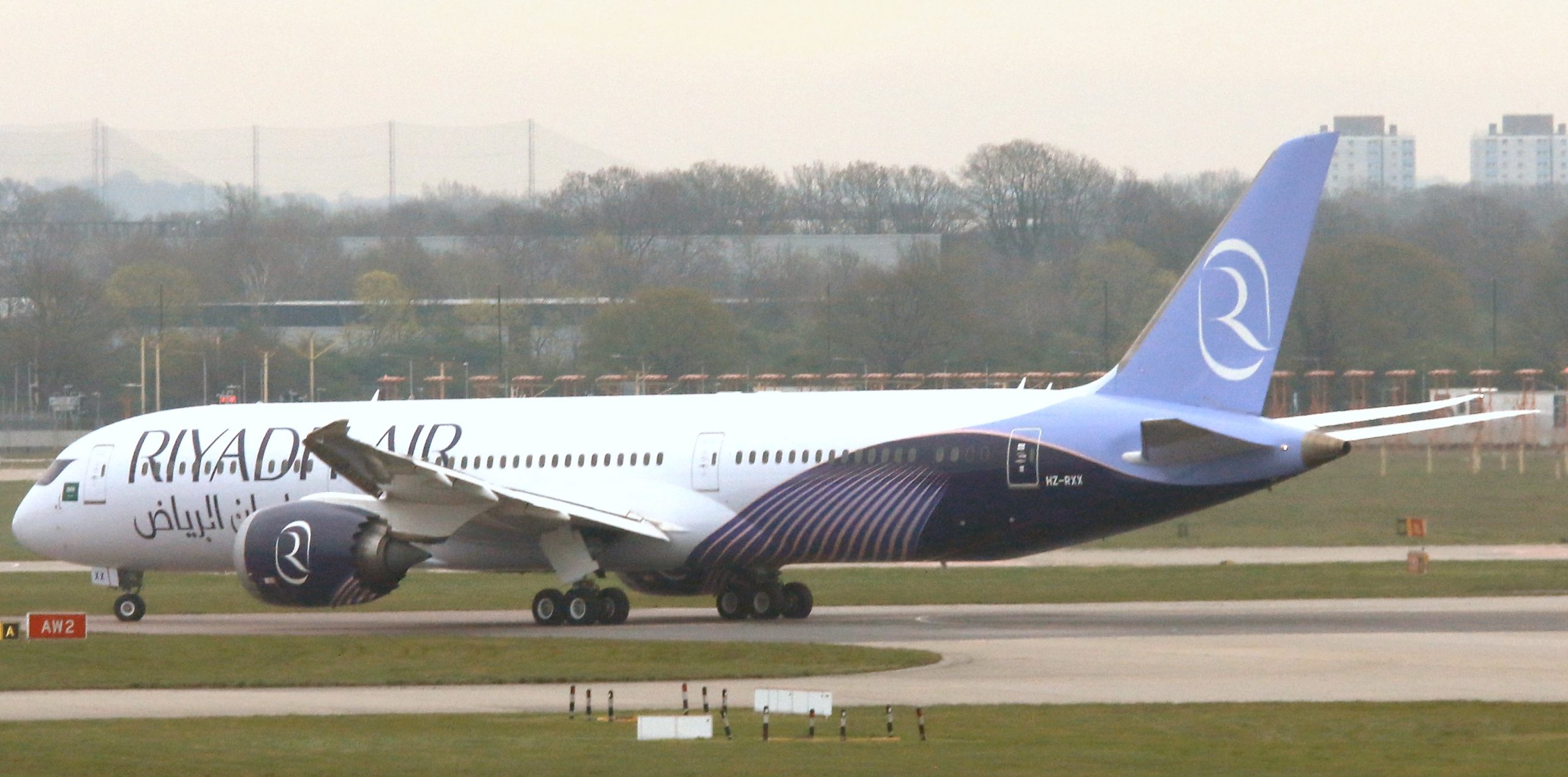
A Riyadh Air Boeing 787-9 Dreamliner, registration HZ-RXX, at London Heathrow. Photo: kitmasterbloke via Wikimedia Commons (CC BY 4.0).