

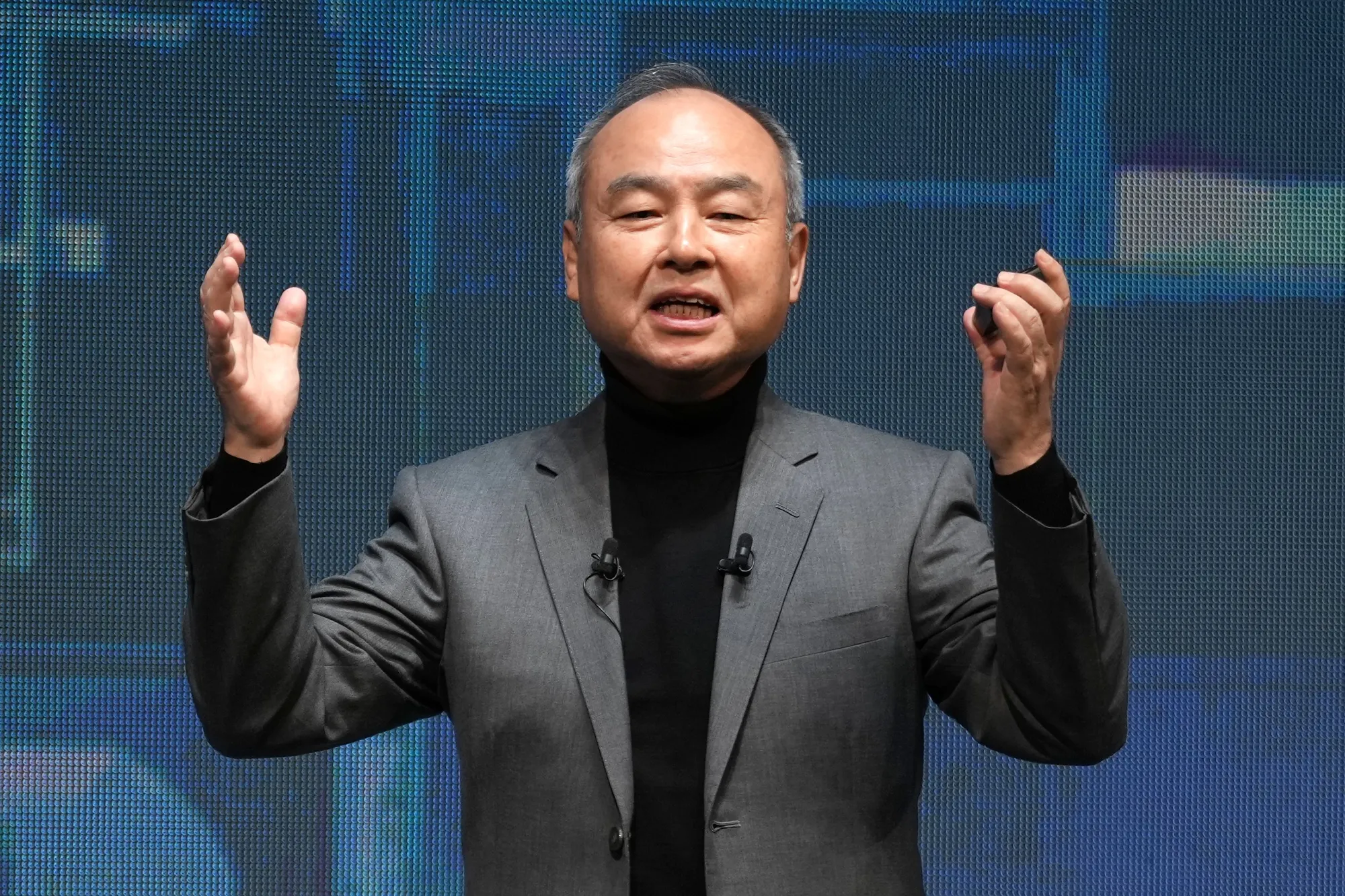
Masayoshi Son has never been the kind of businessman who waits for the future to become obvious.
He prefers to bet on it before most people can see it clearly.
That approach has made him enormously successful at times, and has also cost him billions of dollars at others.
Few technology investors have experienced such extreme swings.
Son built SoftBank from a small Japanese software distributor into a global technology and investment group. He made an extraordinarily early investment in Alibaba that eventually became one of the most famous venture investments in business history.
He also made enormous bets that went badly, including investments connected to companies that later collapsed or lost much of their value.
For Son, however, those successes and failures are part of the same philosophy.
He believes that the biggest opportunities usually require thinking decades ahead and accepting risks that most investors would rather avoid.
His story is therefore not simply about becoming rich.
It is about how one entrepreneur developed an unusual way of looking at technology, capital, and the future, and then built his entire career around that vision.
Growing Up Different
Masayoshi Son was born in 1957 in Tosu, Saga Prefecture, Japan.
His family had Korean roots and lived in Japan at a time when ethnic Koreans often faced discrimination and social barriers.
Growing up, Son became familiar with the feeling of being an outsider.
That experience would later influence his personality and ambition.
He wanted to prove that his circumstances did not have to determine his future.
A Strong Ambition From a Young Age
Son was ambitious from an early age.
He was fascinated by business and technology and wanted to become financially independent.
One of the stories often associated with his youth involves his determination to meet Den Fujita, the Japanese businessman who helped build McDonald’s presence in Japan.
Son reportedly sought Fujita’s advice while still a teenager.
The advice that stayed with him was simple: learn about computers and English.
For Son, it became a direction for the future.
Moving to the United States
As a teenager, Son traveled to the United States.
He eventually enrolled at the University of California, Berkeley.
His time in America was important for more than education.
He was exposed to a rapidly developing technology culture and began to see computers as something much larger than machines used by specialists.
He saw them as tools that could eventually reshape entire industries.
The First Business Idea
While still a student, Son began experimenting with business ideas.
He understood that technology could create opportunities for entrepreneurs who were willing to move quickly.
One of his early projects involved an electronic translator.
The device was reportedly developed with the help of students and engineers and was eventually sold to Sharp.
The deal gave Son his first meaningful business capital.
More importantly, it showed him that a young entrepreneur could take an idea, turn it into a product, and sell it to a major corporation.
A Lesson in Opportunity
The experience reinforced something that would become central to Son’s career.
He did not need to invent everything himself.
He needed to recognize opportunities, connect the right people and technologies, and move quickly when he saw potential.
That way of thinking would later become the foundation of his investment strategy.
Returning to Japan
After graduating from Berkeley, Son returned to Japan.
He founded SoftBank in 1981.
The company initially focused on distributing software.
At the time, Japan’s personal computer market was still developing.
Son believed software would become increasingly important as computers became more common.
It was an early example of his habit of looking at where technology was going rather than where it was at that particular moment.
The Early Years of SoftBank
SoftBank was not an instant success.
The company had to build relationships with software developers, retailers, and computer manufacturers.
Son worked to make SoftBank an important distributor within Japan’s growing technology industry.
He also understood the importance of scale.
Instead of treating software distribution as a small niche business, he wanted SoftBank to become a major platform connecting technology companies with customers.
The First Major Expansion
As SoftBank grew, Son began looking beyond software distribution.
He started acquiring companies and investing in businesses connected to technology and media.
This marked the beginning of a major change in SoftBank’s identity.
It was becoming less like a traditional distributor and more like an investment and technology company.
Betting on the Internet
During the 1990s, Son became increasingly convinced that the internet would transform the global economy.
At the time, many people still viewed the internet as a relatively new and uncertain technology.
Son saw something much bigger.
He believed the internet would become infrastructure for communication, commerce, entertainment, and business.
That belief led him to make a series of aggressive investments.
Yahoo! Japan
One of his early major successes came through Yahoo! Japan.
SoftBank partnered with Yahoo and helped launch Yahoo! Japan in 1996.
The company eventually became one of the most important internet businesses in Japan.
For Son, this was evidence that his strategy could work.
He had invested in an emerging technology before its full commercial potential was obvious.
The Alibaba Bet
Then came the investment that would define Son’s reputation.
In 2000, SoftBank invested approximately $20 million in Alibaba, the young Chinese e-commerce company founded by Jack Ma.
At the time, Alibaba was far from the global giant it would eventually become.
The investment looked extremely risky.
Son, however, saw enormous potential in China’s emerging internet economy.
He was willing to make the bet even when the company’s future was far from certain.
Meeting Jack Ma
Son met Jack Ma and reportedly became convinced by his vision for Alibaba.
The two entrepreneurs approached technology from different backgrounds, but they shared a belief that the internet could transform commerce on a massive scale.
Son decided to invest.
That decision would eventually become one of the most valuable technology investments in history.
Why Alibaba Mattered
Alibaba eventually grew into a global technology and e-commerce powerhouse.
Its expansion dramatically increased the value of SoftBank’s early investment.
The Alibaba stake became a major source of Son’s wealth and provided SoftBank with enormous financial strength.
More importantly, it established Son’s reputation as an investor capable of identifying transformational companies before they became obvious winners.
But Son Was Just Getting Started
The Alibaba investment could have been enough to define an entire career.
For Masayoshi Son, however, it was only one step.
As the technology industry continued to evolve, he became increasingly interested in building a much larger portfolio of companies that could shape the future.
He wanted SoftBank to become something much bigger than a Japanese technology company.
He wanted it to become a global force.
From Technology Company to Global Investment Powerhouse
The Alibaba investment changed the scale of Masayoshi Son’s ambitions.
SoftBank was no longer simply a Japanese company distributing software and investing in emerging technology.
Son now had the capital, confidence, and reputation to pursue much larger opportunities.
And he began thinking on a completely different scale.
Buying Into Telecommunications
One of the biggest moves came in 2006, when SoftBank acquired Vodafone Japan.
The deal was enormous for SoftBank.
It brought the company into the telecommunications business and gave Son access to millions of mobile customers.
For many observers, the move looked risky.
SoftBank was taking on a major established industry with huge capital requirements and powerful competitors.
But Son saw something else.
Mobile communication was becoming one of the most important technologies in people’s daily lives.
He believed SoftBank needed to control more than the software and internet businesses built on top of technology.
It needed a position inside the infrastructure itself.
SoftBank Mobile
After the acquisition, Vodafone Japan was eventually rebranded as SoftBank Mobile.
Son focused heavily on changing the company’s image.
The business needed to become more than a traditional telecommunications provider.
It had to become a technology brand.
SoftBank invested in its network, marketing, devices, and customer experience.
The company also became known for aggressive competition in Japan’s mobile market.
The iPhone Deal
One of SoftBank’s most important telecommunications moves came when it secured the rights to sell the iPhone in Japan.
At the time, Apple was still expanding its international presence, and Japan had a highly competitive mobile market with its own established ecosystem.
Bringing the iPhone to SoftBank customers helped the company differentiate itself from larger competitors.
It also demonstrated another characteristic of Son’s strategy.
He was willing to make aggressive moves when he believed a technology could change consumer behavior.
Thinking Beyond Japan
As SoftBank became stronger, Son increasingly looked outside Japan.
His ambition was no longer simply to build one of the country’s largest technology companies.
He wanted to create a global network of businesses connected to the future of technology.
This led SoftBank into investments and acquisitions across multiple countries and industries.
Sprint
In 2013, SoftBank acquired a majority stake in Sprint, one of the major telecommunications companies in the United States.
The deal was another enormous commitment of capital.
Son believed that scale would be critical in telecommunications and that Sprint could become a stronger competitor with the right investment and strategy.
But the U.S. market proved much harder than expected.
Sprint struggled against larger competitors, and the investment became one of the more difficult chapters in Son’s career.
A Different Kind of Investor
By this point, Son’s strategy had become clear.
He was not trying to make small, conservative investments across hundreds of companies.
He preferred to make large bets on businesses that he believed could become major players in the future.
That approach could generate extraordinary returns when he was right.
But it could also create enormous losses when he was wrong.
The Vision for a Connected Future
Son’s thinking became increasingly focused on what he believed the world would look like decades from now.
He expected computers, smartphones, networks, artificial intelligence, robotics, and connected devices to become deeply integrated into everyday life.
Rather than investing only in today’s biggest companies, he wanted SoftBank to own stakes in the companies that could shape that future.
This philosophy eventually led to one of the most ambitious investment vehicles in modern business.
The Vision Fund
In 2017, SoftBank launched the SoftBank Vision Fund.
The fund was enormous by venture capital standards.
It raised roughly $100 billion in its first major fund, with money coming from SoftBank and outside investors, including Saudi Arabia’s Public Investment Fund.
The scale of the fund changed the venture capital landscape.
Traditional venture capital firms often invested relatively modest amounts in early-stage companies.
Son wanted to write much larger checks.
He believed companies building the infrastructure of the future needed enormous amounts of capital to grow quickly.
Bigger Bets
The Vision Fund invested in a wide range of technology companies.
The portfolio included businesses working in areas such as:
- Artificial intelligence.
- E-commerce.
- Transportation.
- Robotics.
- Real estate technology.
- Fintech.
- Food delivery.
- Enterprise software.
- Logistics.
The strategy was based on a simple idea.
If technology was going to reshape major industries, the companies leading that transformation could become enormously valuable.
The WeWork Problem
But the Vision Fund also exposed the dangers of Son’s approach.
One of its most controversial investments was WeWork.
SoftBank invested billions of dollars in the company, believing that its model could transform commercial real estate.
WeWork’s valuation rose dramatically.
At one point, the company was valued at tens of billions of dollars.
But when it attempted to go public in 2019, investors began questioning its business model, financial performance, corporate governance, and valuation.
The planned IPO collapsed.
WeWork’s valuation fell sharply.
SoftBank was forced to provide additional financial support while recognizing enormous losses.
A Very Expensive Lesson
WeWork became one of the clearest examples of the risk inherent in Son’s investment philosophy.
His willingness to move quickly and invest heavily could create enormous opportunities.
But that same willingness could also lead him to become too optimistic about companies that had not yet proven their business models.
The WeWork experience became a major turning point for SoftBank.
It forced investors and Son himself to confront the limits of betting aggressively on visionary founders and rapidly growing companies.
The Technology Market Turns
The problems did not end with WeWork.
After years of rapidly increasing technology valuations, the market eventually changed.
Interest rates rose.
Investors became more cautious.
Technology companies that had previously attracted enormous valuations faced much greater scrutiny.
Many startups in the Vision Fund portfolio lost significant value.
SoftBank reported some of the largest investment losses in its history.
Son’s Reaction
Son did not abandon his fundamental belief in technology.
Instead, he began emphasizing financial discipline more strongly.
SoftBank became more selective.
The company also began selling some assets and reducing exposure to certain investments.
The goal was to strengthen the balance sheet and create room for the next wave of technological opportunities.
From Internet to Artificial Intelligence
That next opportunity, in Son’s view, was increasingly artificial intelligence.
He became convinced that AI would be as transformative as the internet, and potentially much more important.
Rather than treating AI as simply another software category, Son viewed it as a foundational technology that could affect almost every major industry.
This changed the direction of his thinking once again.
Arm
One of SoftBank’s most important assets in this new era became Arm.
SoftBank had acquired the British semiconductor and chip-design company in 2016.
Arm’s technology is used extensively in processors found in smartphones and many other connected devices.
As computing expanded into mobile devices, cloud infrastructure, automotive systems, and AI applications, Arm became increasingly strategically important.
Why Arm Matters
Arm does not manufacture most of the chips that use its technology.
Instead, it develops processor architectures that companies can license and incorporate into their own semiconductor designs.
That makes Arm an important part of the technology ecosystem.
For Son, owning Arm meant having exposure to the underlying infrastructure supporting the expansion of computing.
The Arm IPO
In 2023, Arm returned to the public markets through an initial public offering in the United States.
The IPO gave SoftBank a valuable publicly traded asset while maintaining its significant ownership of the company.
For Son, Arm represented something particularly important.
It connected SoftBank’s investment strategy to the growing demand for computing power and artificial intelligence.
A Career Built on Contradictions
Masayoshi Son’s career is difficult to summarize with a simple label.
He has made extraordinary investments.
He has also made extraordinarily expensive mistakes.
He has been described as visionary and reckless.
Both descriptions contain some truth.
His willingness to think far ahead has allowed him to identify opportunities that other investors overlooked.
But his confidence in those visions has sometimes led him to commit enormous amounts of capital before the underlying businesses were ready.
That tension is at the heart of his story.
The Philosophy Behind the Risk
Son has often spoken about thinking in decades rather than years.
He does not want SoftBank to be defined by what is successful today.
He wants it positioned for what he believes will become important tomorrow.
This explains why his investments have often looked strange or excessive when viewed in isolation.
He is not necessarily asking:
“What is the best company today?”
He is asking:
“What technology could dominate the next generation?”
The Cost of Being Early
There is another important lesson in Son’s career.
Being early is not always the same as being right.
A technology can eventually become enormously important while the company developing it fails.
A market can grow while a specific investment loses money.
And a brilliant idea can still be attached to a business model that does not work.
Son’s experience with SoftBank demonstrates this distinction repeatedly.
What Makes His Story Different
Unlike many entrepreneurs who build one company and spend decades improving it, Son has spent much of his career moving capital from one technological opportunity to another.
SoftBank became a vehicle for that strategy.
Its identity evolved as technology evolved.
First software.
Then the internet.
Then telecommunications.
Then global technology investing.
Then artificial intelligence and semiconductor infrastructure.
The company kept changing because Son believed the future itself was changing.
The Price of Betting on the Future
Masayoshi Son’s career is difficult to describe as either a straightforward success story or a story of failure.
It contains both.
There were investments that generated extraordinary wealth and others that destroyed billions of dollars in value.
There were moments when Son looked years ahead of everyone else, and moments when his confidence in the future led him too far.
That is what makes his story worth studying.
His greatest strength and his greatest weakness have often been the same thing:
he believes deeply in his vision.
The Alibaba Investment: His Defining Success
The clearest example of Son’s ability to see the future early remains his investment in Alibaba.
When SoftBank invested around $20 million in Alibaba in 2000, the Chinese internet company was still young and largely unknown outside its home market.
The investment looked speculative.
But Alibaba grew into one of the world’s largest technology and e-commerce companies.
The value created by SoftBank’s stake became enormous.
The investment demonstrated the extraordinary power of getting behind the right company before the market fully understands its potential.
It also gave Son the financial resources to pursue much larger opportunities.
But Alibaba Was Not a Formula for Success
The success of Alibaba could have created a dangerous illusion.
After making one of the greatest technology investments of his generation, Son became even more confident in his ability to identify future winners.
That confidence helped fuel SoftBank’s increasingly ambitious investment strategy.
But finding one transformational company does not mean every transformational-looking company will succeed.
The Vision Fund would eventually prove that.
The Vision Fund’s Huge Ambition
The Vision Fund represented Son’s philosophy on an unprecedented scale.
Instead of investing relatively small amounts in dozens of startups, SoftBank could provide billions of dollars to companies it believed could become global leaders.
The strategy was built around speed and scale.
If a company had a promising technology and a large market opportunity, Son wanted to give it enough capital to expand rapidly.
The assumption was that market leadership could become more valuable than short-term profitability.
When Scale Became a Problem
The problem was that rapid growth could hide weaknesses.
Some companies receiving huge investments were expanding faster than their underlying businesses justified.
High valuations created expectations that were difficult to meet.
And when financial markets became less willing to reward growth at any price, those weaknesses became much more visible.
SoftBank’s investment losses grew.
WeWork and the Limits of Vision
WeWork became the most recognizable example.
The company had an ambitious founder and an appealing story about changing the way people work.
Its valuation soared.
SoftBank strongly supported the company.
But the underlying economics were far more complicated than the vision suggested.
When the company attempted to go public, the market rejected its valuation.
The collapse became a painful reminder that a compelling story cannot replace a sustainable business model.
For Son, it was an expensive lesson.
The Market Turns Against Growth
The broader technology market eventually changed as well.
After years of cheap money and aggressive investment, rising interest rates made investors much more cautious.
Companies that had been valued primarily on future growth were suddenly judged more heavily on revenue quality, profitability, cash flow, and realistic paths to sustainable businesses.
The same environment that had rewarded Son’s aggressive strategy began working against it.
Losses Measured in Billions
SoftBank reported enormous investment losses during the technology downturn.
The numbers were so large that they attracted global attention.
But Son did not abandon technology.
He continued to believe that the next major transformation would come from artificial intelligence.
This is an important part of understanding his personality.
When one investment thesis fails, he does not necessarily abandon the broader idea.
He asks whether the timing was wrong, the company was wrong, or the technology itself was wrong.
The AI Bet
Son increasingly came to view artificial intelligence as the next defining technology.
He believes AI could transform industries ranging from software and manufacturing to healthcare, transportation, finance, and robotics.
For him, AI is not simply another category of software.
It is potentially a new layer of infrastructure for the global economy.
That belief has pushed SoftBank toward a renewed focus on AI-related investments and technologies.
Arm at the Center
Arm has become particularly important to this strategy.
The company’s processor architecture is used across a huge range of devices.
As AI requires more computing power, demand for efficient processor designs is expected to remain significant.
SoftBank’s ownership of Arm therefore gives Son exposure to a fundamental part of the computing industry.
Rather than betting only on individual AI applications, he can benefit from the infrastructure underneath them.
A Different Kind of Entrepreneur
Masayoshi Son is not a traditional entrepreneur in the same way Steve Jobs was.
Jobs focused intensely on a small number of products.
Son focuses on capital allocation.
His product is, in a sense, the portfolio itself.
He wants to identify where technology is going, find the companies capable of getting there, and provide them with enough capital to move quickly.
That makes him closer to a combination of entrepreneur, investor, and strategist.
The Importance of Timing
Son’s career also demonstrates how important timing is in technology investing.
The same company can look brilliant in one market environment and terrible in another.
Capital can be abundant one year and expensive the next.
Investors can reward growth aggressively, then suddenly demand profitability.
A business that survives one cycle may struggle in another.
This means that even a good investment thesis can produce poor financial results if the timing is wrong.
Risk and Conviction
Son’s approach to risk is unusual.
He does not appear to believe that avoiding risk is the goal.
Instead, he tries to distinguish between ordinary risk and opportunities with enormous potential.
He is willing to accept the possibility of large losses if he believes the upside could be transformative.
The problem, of course, is determining whether the opportunity really is transformative.
That is where judgment becomes critical.
What Entrepreneurs Can Learn From Masayoshi Son
1. Think Beyond the Present
Son built much of his career by asking where technology was heading rather than where it was today.
Entrepreneurs can benefit from asking what their industry could look like five or ten years from now.
2. Capital Is a Tool
Money is not the business itself.
The real question is what that capital allows a company to build.
Son repeatedly used capital to accelerate businesses he believed had exceptional potential.
3. Big Opportunities Require Big Decisions
The Alibaba investment would never have produced extraordinary returns if Son had been unwilling to make a meaningful commitment.
Sometimes small decisions produce small outcomes.
4. Vision Needs Discipline
This may be the most important lesson from Son’s mistakes.
A powerful vision can attract investors, employees, and customers.
But vision alone does not guarantee that a business model works.
Growth must eventually translate into sustainable economics.
5. Learn From Failure Without Abandoning the Bigger Goal
Son experienced some of the largest investment losses in modern technology.
Yet he did not conclude that technology investing was a mistake.
Instead, he adjusted his strategy and continued searching for the next major opportunity.
6. Being Early Has a Cost
Seeing the future before everyone else can be an advantage.
But it can also be expensive.
The market may not be ready.
The technology may need more time.
Or the company you backed may not be the one that ultimately wins.
Being right about a trend does not automatically mean being right about an investment.
Masayoshi Son’s Wealth
Son’s enormous fortune has been closely connected to his ownership of SoftBank and the value of the company’s investments.
But unlike a founder whose wealth comes primarily from one operating business, Son’s financial position has been heavily influenced by the performance of a broad portfolio.
That means his wealth can rise or fall significantly with technology markets.
It also reflects the nature of the strategy he has chosen.
High exposure to technology creates the possibility of extraordinary gains, but also substantial volatility.
More Than a Billionaire
The most interesting way to understand Masayoshi Son is not simply as a billionaire.
He is someone who has spent decades trying to answer one question:
What will the world look like next?
He built companies and investment structures around his answers.
Sometimes those answers were remarkably accurate.
Sometimes they were not.
But he continued to make decisions based on a long-term view rather than simply following what was popular at the moment.
Legacy
Son has already left a significant mark on the technology industry.
SoftBank helped finance the growth of numerous technology companies around the world.
His early investment in Alibaba became one of the most famous venture investments ever made.
His Vision Fund changed the scale and expectations of technology investing.
And his continued focus on semiconductors and artificial intelligence has positioned SoftBank around technologies that could shape the next generation of computing.
His legacy, however, will ultimately depend not only on the investments that succeeded but also on what he learned from the ones that failed.
Final Thoughts
Masayoshi Son’s story is not a lesson about always being right.
It is almost the opposite.
His career shows what can happen when an entrepreneur is willing to make unusually large bets on ideas that are still uncertain.
Sometimes those bets create extraordinary value.
Sometimes they produce extraordinary losses.
The difference often comes down to judgment, timing, execution, and the ability to recognize when a vision is no longer supported by reality.
Son’s greatest success was not simply investing in Alibaba.
It was developing the courage to make a meaningful bet before Alibaba’s future was obvious.
His greatest failures show the other side of that same philosophy.
A powerful vision can be an extraordinary advantage, but it can also become dangerous when conviction turns into certainty.
And perhaps that is the most valuable lesson from his career:
You need the courage to bet on the future, but you also need enough discipline to admit when the future is not unfolding the way you expected.