

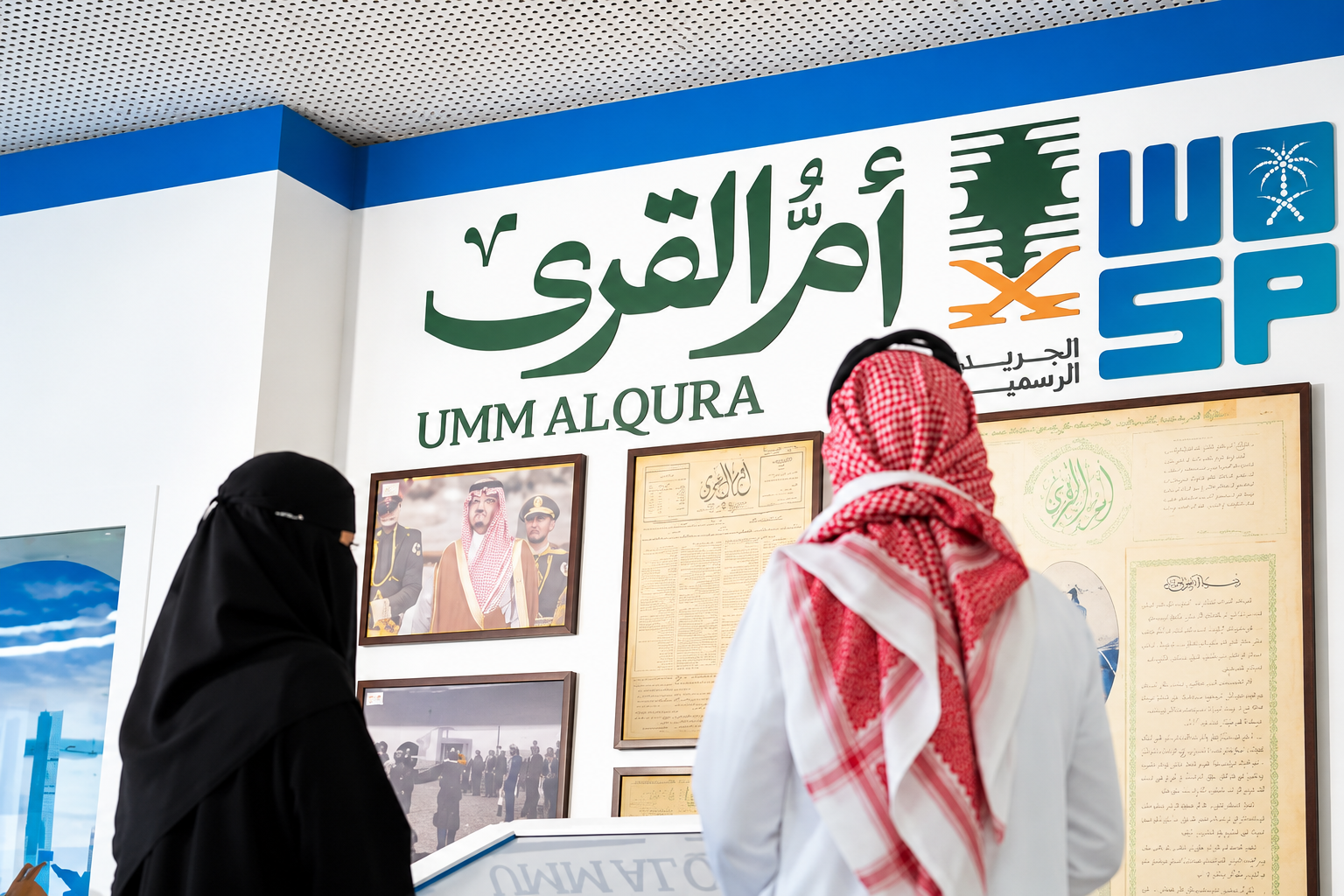
The Security and History Dialogue conference in Riyadh is offering visitors a glimpse into Saudi Arabia’s historical memory through an accompanying exhibition featuring rare photographs, documents, weapons and heritage artifacts, including swords believed to be more than three centuries old.
The exhibition brings together contributions from several Saudi government entities, presenting historical material that traces the development of state institutions, the armed forces and Riyadh itself across different periods.
Swords Dating Back More Than Three Centuries
Among the exhibition’s most notable displays are a collection of rare swords, some of which are more than 300 years old, offering a tangible connection to periods predating the development of Saudi Arabia’s modern security and military institutions.
The Ministry of National Guard pavilion also featured a collection of historic weapons and artifacts, including the Al-Sam’a rifle, manufactured in 1899, and a long Mauser rifle produced in 1936 bearing the emblem of the King of Hejaz and Nejd.
The collection also included traditional rifles known by historical names such as Al-Fatil, Umm Sk, Umm Talqa, Umm Sanduq and Al-Naims, alongside rare swords reflecting the region’s long history of traditional weaponry.
“Al-Riyadh” and the Early Development of the Navy
The Ministry of Defense pavilion displayed more than 20 rare historical photographs documenting different stages in the development of Saudi Arabia’s armed forces.
Among them was a photograph showing an M8 armored vehicle parade, connected to the establishment of the Saudi armored corps in 1353 AH.
The pavilion also displayed a historical photograph of the Al-Riyadh boat, described as the first combat naval vessel, launched on 23 Dhu Al-Qi’dah 1379 AH. The display highlights an early stage in the development of Saudi naval capabilities.
Beyond the equipment itself, the photographs provide a visual record of how Saudi military institutions evolved over several decades.
Rare Images of King Abdulaziz and Historic Riyadh
The King Fahd National Library contributed another important part of the exhibition, displaying rare photographs of King Abdulaziz Al Saud during his youth, along with historical images of Riyadh and Diriyah.
The collection also included manuscripts and documents bearing annotations associated with members of the ruling family, as well as stamps used during the period of the Kingdom’s unification.
Together, these materials provide visitors and researchers with access to primary historical artifacts, adding an archival dimension to the conference’s broader discussion of Saudi history.
Riyadh Through the Years
The exhibition also highlights the dramatic transformation of the Saudi capital.
The Royal Commission for Riyadh City presented albums and historical photographs showing the city during earlier periods, including images of Thumairi Gate, the Southern Riyadh Gate, Al-Batha Road, Al-Safah, Dukhna mosques, Haraj Market and the Grand Mosque, as well as an aerial photograph of Al-Murabba district.
The collection illustrates how Riyadh’s urban fabric evolved from a relatively compact traditional city into a modern capital with a vast metropolitan footprint and growing economic and political importance.
The photographs therefore offer more than a nostalgic look at the past. They help place Riyadh’s current transformation within a much longer process of urban, social and institutional development.
Connecting History With the Present
The exhibition forms part of the Security and History Dialogue conference, which examines the relationship between security, stability and state-building while revisiting different stages of Saudi Arabia’s historical experience.
The approach connects institutional history with the development of the Kingdom’s security, military and urban sectors, showing how accumulated experience over generations contributed to the formation of modern state institutions.
Displaying centuries-old artifacts alongside more recent photographs and official documents also allows visitors to follow this transformation across time, from traditional weapons and early military capabilities to increasingly sophisticated institutions.
More Than 160 Speakers and 65 Sessions
The Security and History Dialogue concludes in Riyadh on September 8, 2026, following a program featuring more than 65 sessions and interactive meetings with the participation of more than 160 speakers, including leaders, experts and academics.
The event combines discussions with the accompanying exhibition and a series of knowledge and cultural activities, creating a broader platform for examining security, history and the evolution of state-building in Saudi Arabia.
From a sword that has survived for more than three centuries to a rifle manufactured in the late 19th century, rare photographs documenting the development of the armed forces and archival material capturing old Riyadh and Diriyah, the exhibition demonstrates how the past can provide essential context for understanding the Kingdom’s present and future.