


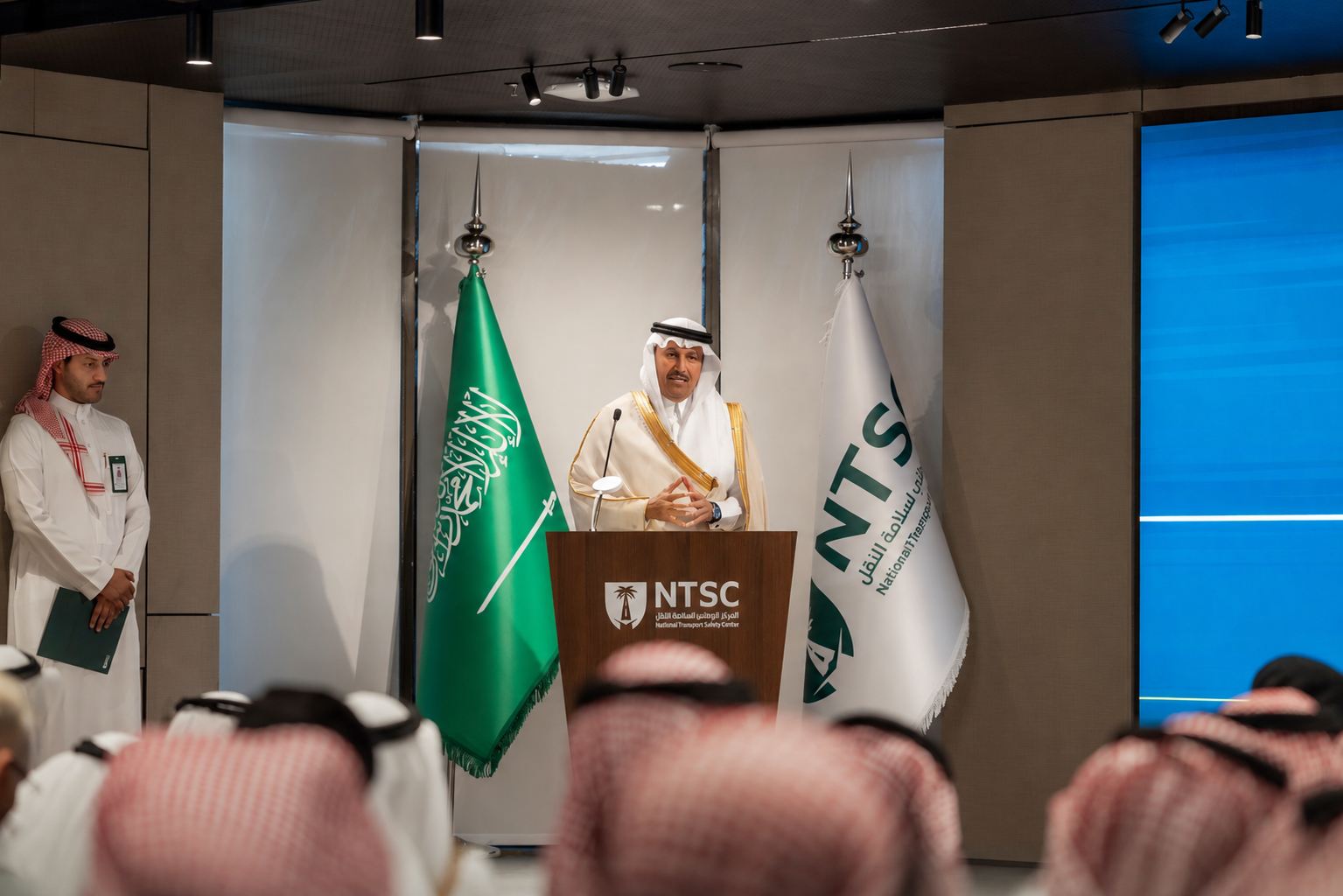
Saudi Minister of Transport and Logistics Services and Chairman of the National Transportation Safety Center, Eng. Saleh bin Nasser Al-Jasser, inaugurated the center’s headquarters in Riyadh, marking an important step in strengthening its institutional and technical capabilities and enhancing its role in improving safety across all modes of transportation in the Kingdom.
The inauguration was attended by senior officials and members of the center’s Board of Directors. During a tour of the headquarters, Al-Jasser reviewed its specialized facilities and departments and received briefings on the center’s operating system, projects, initiatives, and technical and technological capabilities supporting its safety investigation activities in line with international standards and best practices.
Specialized Facilities to Support Safety Investigations
The new headquarters includes a range of specialized facilities designed to strengthen the center’s operations and improve its investigative capabilities.
Among them is an engineering laboratory equipped with advanced technologies used to document and analyze accident sites and reconstruct incidents. These capabilities are designed to help specialists develop a clearer understanding of the root causes of accidents and the factors contributing to them.
The headquarters also houses the Transportation Safety Observatory, which supports the monitoring and analysis of transportation safety data and contributes to informed decision-making.
Another key facility is the Operations Control Center, which operates around the clock to strengthen the center’s readiness, monitor operations, and respond efficiently to emerging developments.
The headquarters also includes a training facility dedicated to developing national expertise and building specialized capabilities in transportation safety and accident investigation.
Investigating Major Accidents and Identifying Root Causes
The National Transportation Safety Center is responsible for conducting safety investigations into major transportation accidents and identifying their root causes and contributing factors.
Its role extends beyond investigating accidents after they occur. The center also develops preventive and advisory recommendations based on scientific methodologies, with the aim of reducing the likelihood of recurring incidents and improving overall transportation safety.
It also provides technical consultations, conducts studies and research, and offers specialized training programs, helping strengthen professional knowledge and expertise across the transportation sector.
Supporting Data-Driven Decision-Making
The center plays an important role in supporting decision-making by analyzing transportation safety data and developing a knowledge base informed by international best practices and experiences.
Such data and analysis can contribute to the development of policies, regulations, and procedures related to transportation safety, while helping authorities better understand risks and improve the efficiency of the transportation system.
Data-driven safety management is increasingly important in modern transportation systems, allowing authorities to move beyond simply responding to accidents and instead use trends and indicators to develop more effective preventive measures.
Strengthening Cooperation and Data Exchange
The inauguration ceremony also included the signing of two memoranda of understanding between the National Transportation Safety Center and the Insurance Authority and the National Center for Meteorology. The agreements aim to strengthen cooperation, integration, and the exchange of data and expertise in support of transportation safety efforts.
The agreements highlight the importance of coordination among government entities and institutions involved in transportation safety, particularly as improving safety requires access to accurate and diverse datasets that can be analyzed and applied to policymaking.
The exchange of expertise and knowledge can also strengthen risk-management practices and improve the ability of relevant authorities to respond effectively to emerging challenges.
Building an Integrated Transportation Safety System
National Transportation Safety Center CEO Capt. Tay bin Abdulrahman Al-Shammari described the inauguration of the headquarters as an important milestone in the center’s development, reflecting the support it receives to fulfill its role in enhancing transportation safety.
He noted that the headquarters’ specialized facilities and advanced capabilities would improve the center’s performance and strengthen its capacity in monitoring, analysis, safety investigations, and the development of specialized national talent.
The headquarters forms part of a broader effort to establish an integrated transportation safety system based on national expertise, modern technologies, and international best practices.
Supporting Saudi Vision 2030
The inauguration of the National Transportation Safety Center headquarters is aligned with the objectives of Saudi Vision 2030, which places strong emphasis on infrastructure development, improving transportation and logistics services, and enhancing quality of life.
The center’s role also supports the National Transport and Logistics Strategy, which identifies transportation safety as a key component of the Kingdom’s efforts to develop the sector and strengthen Saudi Arabia’s position as a global logistics hub.
The strategy seeks to establish a safer and more sustainable transportation sector by developing institutional and technical capabilities, adopting modern technologies, and expanding the use of data and analytics in decision-making.
The new headquarters represents another step in this direction by bringing together monitoring, analysis, investigation, and training capabilities within a specialized environment designed to support the center’s operations.
Toward a Safer and More Sustainable Transportation Sector
The establishment of a specialized national transportation safety center reflects Saudi Arabia’s broader efforts to develop an integrated system for managing accidents and risks across different modes of transportation, including roads, railways, maritime transport, and aviation.
Through specialized investigations, data analysis, and the development of preventive recommendations, the center can contribute to improving safety procedures, regulations, and operational practices.
As Saudi Arabia continues to expand its transportation networks, infrastructure, and major development projects, the importance of a modern safety system capable of keeping pace with technological and operational growth is also increasing.
The inauguration of the National Transportation Safety Center’s headquarters in Riyadh therefore represents a further investment in institutional, technical, and human capabilities, supporting the development of a safer, more reliable, and sustainable transportation sector while helping protect lives and assets and strengthening Saudi Arabia’s position in transportation safety regionally and internationally.














