


Saudi Arabia has reaffirmed its commitment to advancing regional and international efforts to protect marine resources, promote sustainable fisheries and combat illegal, unreported and unregulated fishing (IUU fishing), emphasizing that effective marine governance is essential to global food security and the long-term health of marine ecosystems.
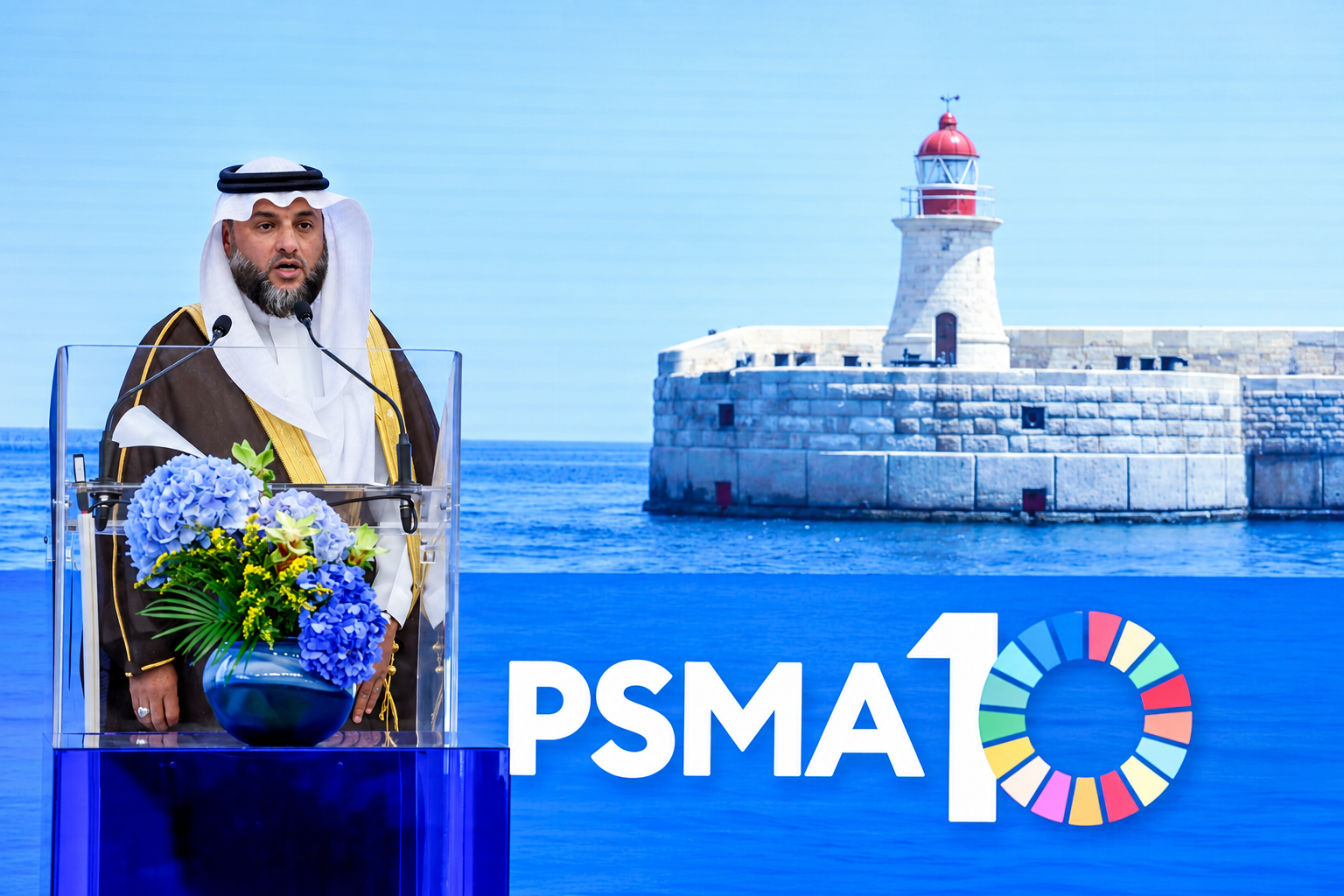
The Kingdom presented its position during its participation in the 37th Session of the FAO Committee on Fisheries (COFI37) and a high-level event marking the 10th anniversary of the entry into force of the Port State Measures Agreement, held at the headquarters of the Food and Agriculture Organization of the United Nations in Rome.
The Saudi delegation was led by Dr. Ali Al-Shaikhi, Assistant Deputy Minister for Animal and Fisheries Resources at the Ministry of Environment, Water and Agriculture.
Oceans as a Shared Resource and Foundation for Food Security
Dr. Al-Shaikhi emphasized that Saudi Arabia views the oceans and seas as a shared heritage and a foundation for food security, development and prosperity.
Marine challenges, he noted, extend beyond national borders and therefore require coordinated international action based on cooperation, transparency, innovation and effective implementation.
The approach reflects the growing recognition that marine sustainability is not only an environmental issue. Fisheries, aquaculture and healthy marine ecosystems are increasingly linked to food security, economic resilience and the livelihoods of coastal communities.
Strengthening Saudi Arabia’s Fisheries Management System
In line with the objectives of Saudi Vision 2030, the Kingdom is continuing to develop its national fisheries management system by strengthening governance, compliance and enforcement frameworks while improving inspection efficiency and data quality.
Saudi Arabia is also expanding the use of modern technologies for monitoring, tracking and data analysis, helping improve oversight of marine activities, strengthen supply-chain transparency and support more sustainable management of marine resources.
Accurate data can also improve policymaking by allowing authorities to better understand fishing activities, identify risks and make more informed decisions about resource management.
The Red Sea at the Center of Sustainability Efforts
The Red Sea holds particular importance in Saudi Arabia’s marine sustainability efforts because of its unique biodiversity and environmentally, economically and developmentally significant ecosystems.
The Kingdom is working to establish a balance between development ambitions and the need to protect sensitive marine habitats.
Measures include regulating fishing activities, strengthening monitoring and traceability, improving the management of landing operations and encouraging responsible and sustainable fishing practices.
The approach reflects the Kingdom’s view of the Red Sea as more than a natural resource: it is part of an integrated environmental and economic system whose long-term value depends on effective protection and responsible utilization.
Regional Cooperation to Protect the Red Sea
Saudi Arabia also emphasized the importance of strengthening cooperation among Red Sea coastal states, particularly through information and data sharing, coordinated inspection and enforcement activities and capacity building.
Because marine activities and seafood supply chains frequently cross national boundaries, cooperation among neighboring countries is essential for addressing illegal fishing and improving oversight.
The Kingdom therefore highlighted the importance of greater integration between flag, coastal, port and market states, creating a more comprehensive system for monitoring marine activities, verifying product origins and enforcing international standards.
Moving From Traditional Enforcement to Smart Monitoring
One of the key messages from Saudi Arabia was the need to move from traditional monitoring toward smart enforcement.
The transition involves greater reliance on monitoring and tracking systems, advanced data analysis and modern technologies, enabling authorities to identify high-risk activities and respond more efficiently.
It also represents a shift from primarily reacting to violations after they occur toward anticipating and preventing violations, supported by connected data systems and stronger coordination among relevant authorities and countries.
Such a model could help close gaps that allow illegal, unreported and unregulated fishing activities to persist.
Combating IUU Fishing as a Global Priority
Illegal, unreported and unregulated fishing remains one of the major challenges facing sustainable fisheries management worldwide.
It can place additional pressure on fish stocks, undermine legitimate fishing operations and weaken the effectiveness of national and international fisheries regulations.
Saudi Arabia’s participation in COFI37 reflects its commitment to international cooperation, knowledge exchange and the development of stronger tools to address these challenges.
The 37th session of the Committee on Fisheries is addressing major issues across fisheries and aquaculture, including the State of World Fisheries and Aquaculture 2026 report, progress in combating IUU fishing and implementation of relevant international instruments.
The agenda also covers climate-change adaptation and mitigation, as well as support for small-scale fisheries and aquaculture.
Healthy Oceans and Global Food Security
Marine resource protection is closely linked to food security, particularly given the contribution of fisheries and aquaculture to food supplies, employment and coastal economies.
Protecting fish stocks and marine ecosystems is therefore not simply an environmental objective. It is also a long-term investment in communities’ ability to maintain reliable food sources and achieve sustainable economic development.
Better resource management can strengthen seafood supply chains, improve confidence in marine products and generate greater economic value without exhausting the resources on which the sector depends.
Turning International Commitments Into Sustainable Results
Saudi Arabia reaffirmed its commitment to working with the Food and Agriculture Organization of the United Nations, member states, regional and international organizations and partners to strengthen fisheries governance, combat illegal fishing and support sustainable marine resources.
The Kingdom aims to help translate international commitments into practical measures and measurable outcomes, ensuring that marine-resource protection becomes a lasting component of national, regional and global policies.
Saudi Arabia’s participation in COFI37 reflects a broader approach to building more integrated marine systems that bring together environmental protection, technology, governance, food security and international cooperation.
As the importance of oceans continues to grow across food, economic, energy and transportation systems, protecting marine resources increasingly requires smarter monitoring, stronger data and cooperation that extends beyond national borders to ensure that marine wealth remains a sustainable resource for current and future generations.