


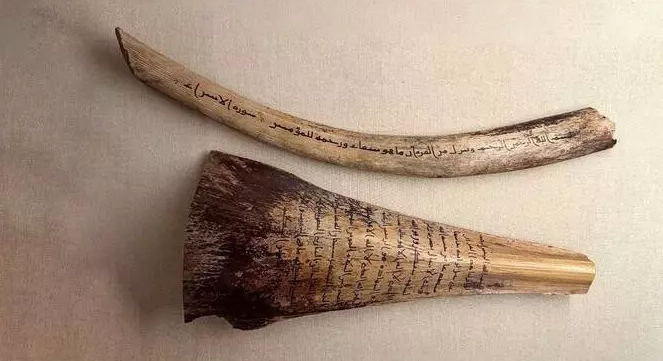
Long before paper became widely available and before the Holy Qur’an was compiled into a single Mushaf, the revelations were carefully recorded on simple materials including leather, palm stalks, stones, wood, and animal bones.
Today, the Holy Qur’an Museum in the Hira Cultural District of Makkah brings this remarkable chapter of Islamic history back to life through immersive exhibits that showcase how the earliest verses were preserved during the Prophet Muhammad’s ﷺ lifetime.
How Was the Qur’an Written?
The museum displays replicas of the original materials used by the scribes of revelation, including:
- Tanned leather (Adeem)
- Palm stalks
- Wooden pieces
- Flat stones
- Animal shoulder and rib bones
These exhibits demonstrate how early Muslims used every available writing surface to document and preserve the divine revelation with exceptional care.
Leather Was the Primary Writing Material
Among all writing materials, tanned leather was the most widely used because of its durability and ability to preserve written text over long periods.
Prepared animal hides became one of the most reliable surfaces for recording Qur’anic verses, playing a crucial role in safeguarding the revelation during the Prophet’s era.
The Scribes of Revelation
The museum highlights the meticulous process through which the Qur’an was documented.
Whenever new verses were revealed, Prophet Muhammad ﷺ instructed the scribes of revelation to write them immediately while also specifying their exact placement within each Surah. This ensured the Qur’an was preserved accurately and in its divinely revealed order.
The exhibits pay tribute to the dedication of the scribes, whose work became one of history’s greatest preservation efforts.
An Interactive Journey Through Qur’anic History
Visitors experience much more than historical artifacts.
Modern galleries feature interactive displays, multimedia presentations, and educational exhibits explaining the history of the Qur’an, the compilation of the Mushaf, and the evolution of Qur’anic manuscripts throughout Islamic history.
Each exhibit explains why specific materials were chosen, how they were prepared for writing, and the historical context in which they were used.
A Cultural Landmark in Makkah
Located within the Hira Cultural District, the Holy Qur’an Museum has become one of Makkah’s leading cultural attractions, introducing visitors to the early history of Islam and the preservation of the Holy Qur’an.
By combining authentic historical documentation with modern museum technology, the museum offers an engaging educational experience for visitors from around the world while highlighting the extraordinary efforts made by early Muslims to preserve the words of Allah long before the Qur’an was compiled into the Mushaf known today.














