


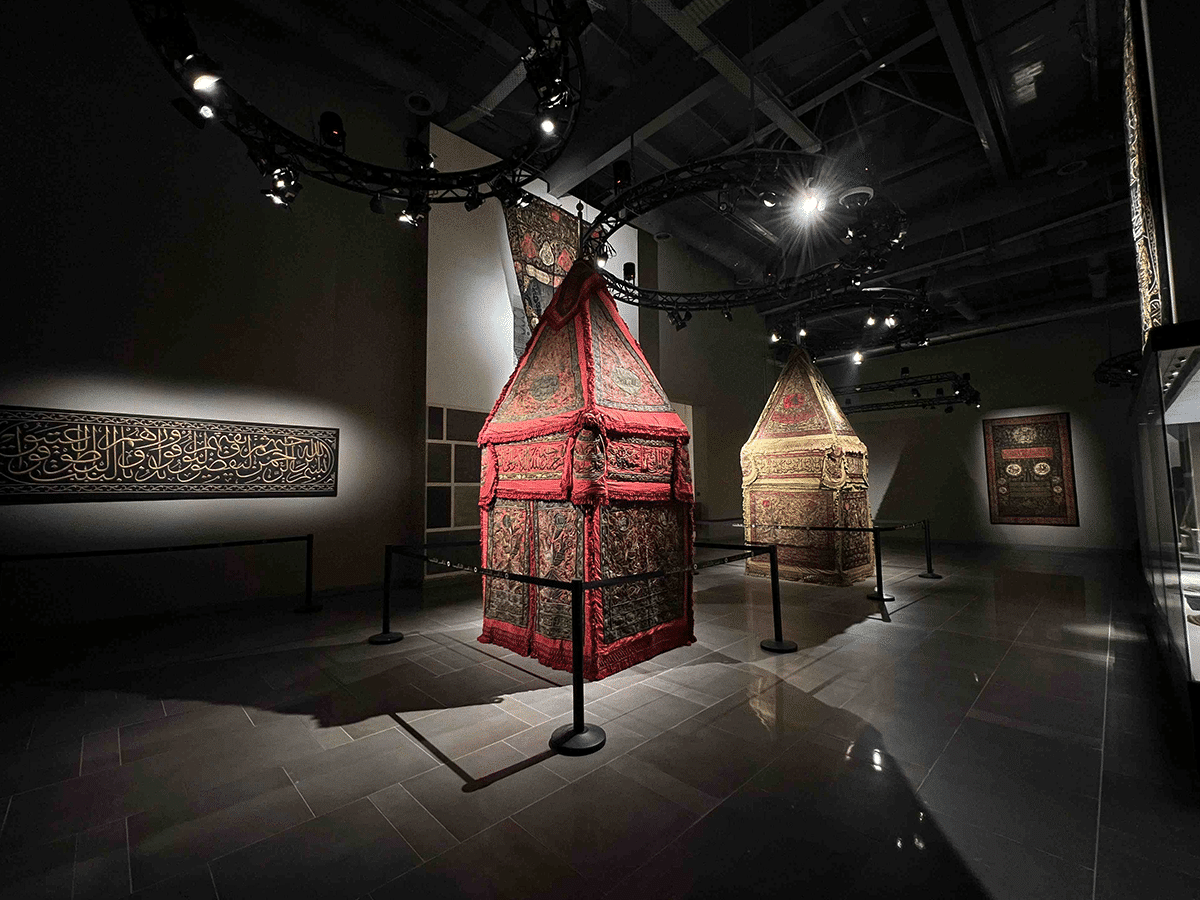
The House of Islamic Arts in Jeddah, the Kingdom’s first museum dedicated entirely to Islamic art, offers visitors a journey spanning approximately 15 centuries of artistic and cultural history through a collection of more than 1,000 rare artifacts.
Its collection reflects craftsmanship and innovation from across the Islamic world, stretching geographically from China and India to the Maghreb and Andalusia and illustrating the extraordinary diversity of Islamic artistic traditions.
Rare Qur’anic Manuscripts and Arabic Calligraphy
One of the museum’s major highlights is its Arabic calligraphy collection, featuring rare Qur’anic manuscripts that document the evolution of Arabic writing and its development into a major form of spiritual and artistic expression.
Among its remarkable pieces is a 2.6-meter-long fabric containing one-third of the Holy Qur’an written in microscopic script.
Another manuscript features letters containing the Names of Allah, demonstrating the extraordinary precision and craftsmanship associated with Islamic calligraphic traditions.
Thousands of Islamic Coins Trace Centuries of History
The museum also houses thousands of Islamic coins covering different periods of history, from the early Islamic state through the Umayyad and Abbasid eras and later Islamic dynasties.
Beyond their monetary significance, the coins provide valuable insights into economic systems, political history, inscriptions, artistic styles and the geographic diversity of Islamic civilization.
Ceramics, Textiles and Architecture
The collection extends beyond manuscripts and coins to include ceramics, textiles and architectural elements representing different periods and regions.
Together, these objects illustrate how Islamic artistic traditions evolved across diverse societies while maintaining recognizable aesthetic principles expressed through geometry, ornamentation, calligraphy and craftsmanship.
Connecting Islamic Heritage With Future Generations
The House of Islamic Arts is designed as more than a traditional exhibition space. Interactive displays, temporary exhibitions, workshops and lectures transform the museum into an educational and cultural platform.
These programs allow visitors to explore the historical context behind the artifacts while introducing younger generations to centuries of Islamic artistic achievement.
With a collection spanning 15 centuries and regions across the Islamic world, the museum represents an important addition to Jeddah’s cultural landscape and the Kingdom’s broader efforts to preserve, study and present Islamic heritage to contemporary audiences.














