


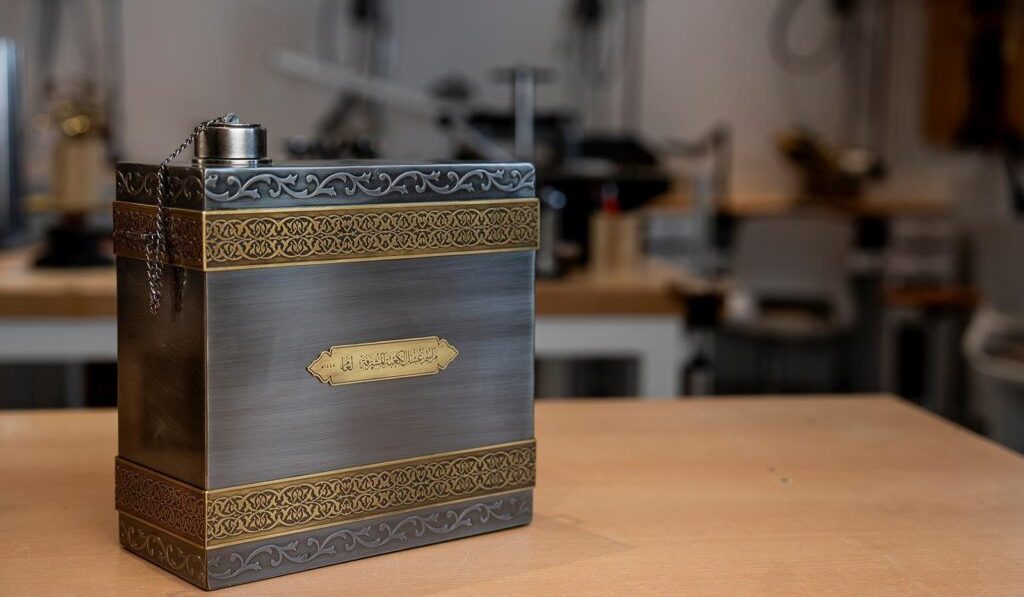
The tools used this year for washing the Holy Kaaba were far more than ceremonial equipment. They were the result of an exceptional national project that required more than 300 working hours over 50 days inside the workshops of the Royal Institute of Traditional Arts, Wrth.
The initiative brought together craftsmanship, heritage, and the honor of serving one of Islam’s holiest sites.
The project represents a powerful example of preserving traditional craftsmanship while applying it to one of the most sacred annual ceremonies in the Islamic world.
It was carried out in partnership with the General Authority for the Care of the Grand Mosque and the Prophet’s Mosque, reflecting strong institutional cooperation in serving the Two Holy Mosques.
From Training to Real-World Application
The project offered Wrth students a unique educational experience that extended beyond classroom learning into practical application.
Students had the opportunity to participate directly in crafting tools used in the Kaaba washing ceremony, transforming their technical skills into real products built according to precise standards.
This reflects the institute’s philosophy of connecting education with hands-on experience and meaningful cultural projects.
Traditional Arts Serving a Sacred Purpose
The project involved crafting several tools used during the Kaaba washing ceremony by integrating multiple traditional art disciplines, including:
- Metalwork
- Wood craftsmanship
- Hand embroidery
Each piece reflected precision, artistic beauty, and exceptional craftsmanship.
Student Sultan Al-Asmari, specializing in metalwork, contributed to designing decorative patterns inspired by Arabic calligraphy featured on the Kaaba’s Kiswah.
Craftsman and trainer Abdulkarim Al-Shahri created the wooden incense burner used in the ceremony and also contributed to designing the transport cart for the tools.
Meanwhile, artisan and trainer Manal Bin Dayel completed the hand embroidery work for the ceremonial towel used in washing the Kaaba.
Preserving Heritage and Empowering Artisans
This project reflects Wrth’s commitment to involving students and artisans in meaningful national initiatives with strong religious and cultural significance.
Its impact extends beyond training by empowering artisans, strengthening the presence of traditional arts in major events, and reinforcing their importance as a vital part of cultural identity.
The initiative also helps preserve traditional craftsmanship by adapting heritage skills to modern applications.
Wrth’s Role in Preserving Traditional Arts
The Royal Institute of Traditional Arts continues to offer advanced educational and specialized programs in fully equipped workshops.
The institute plays a major role in preserving and documenting traditional arts, developing craftsmanship, empowering artisans, and encouraging younger generations to master these cultural skills.
These efforts reflect the Kingdom’s commitment to preserving cultural heritage while strengthening its identity on both regional and global levels.














