


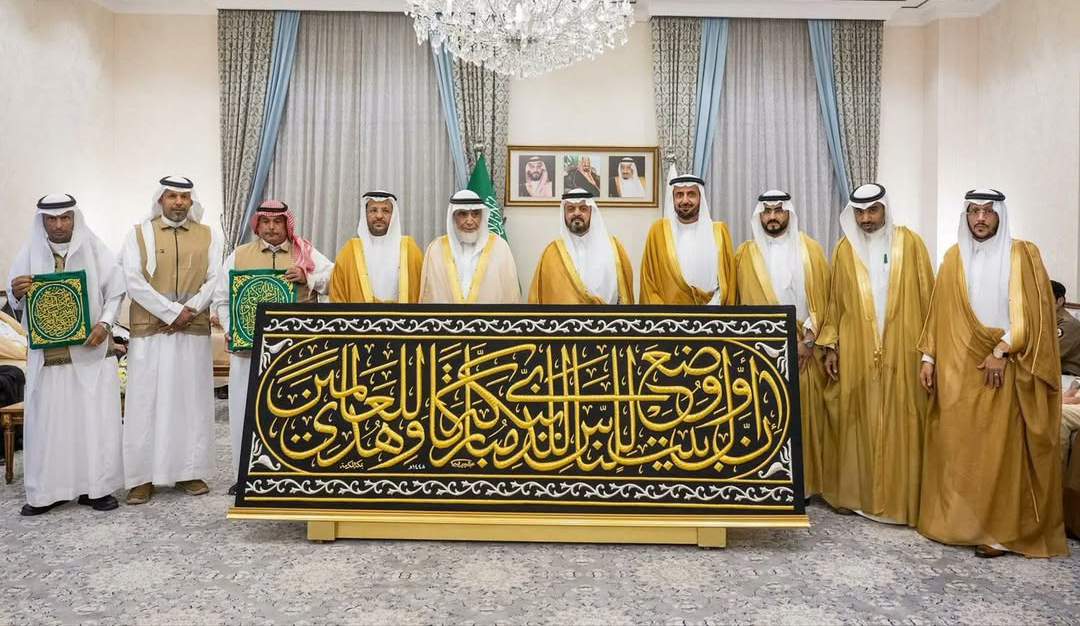
On behalf of Custodian of the Two Holy Mosques King Salman bin Abdulaziz, Prince Saud bin Mishaal bin Abdulaziz, Deputy Governor of the Makkah Region and Vice Chairman of the Permanent Hajj and Umrah Committee, officially handed over the new Kiswa of the Holy Kaaba to the custodians of the Sacred House.
The handover ceremony marks one of the most significant annual traditions associated with the care and maintenance of the Holy Kaaba.
The official transfer documents were signed by Minister of Hajj and Umrah and Chairman of the General Authority for the Care of the Grand Mosque and the Prophet’s Mosque, Tawfiq Al-Rabiah, along with Abdul Malik Al-Shaibi, the Senior Custodian of the Holy Kaaba.
Preparations for the New Hijri Year
The ceremony signals the upcoming replacement of the Kaaba’s covering at the beginning of Muharram 1448H, following the completion of the new Kiswa at the King Abdulaziz Complex for the Holy Kaaba Kiswa.
The facility is regarded as one of the world’s leading centers dedicated to the production of the Kaaba’s covering.
The Kiswa is crafted from high-quality natural black silk and adorned with Quranic verses and intricate Islamic patterns embroidered with gold- and silver-plated threads.
Remarkable Craftsmanship and Design
The Kaaba’s covering stands approximately 14 meters high, while the decorative belt surrounding its upper section measures 95 centimeters in width and 47 meters in length.
The belt consists of 16 elaborately embroidered sections featuring detailed Islamic calligraphy and artistic motifs that reflect centuries of craftsmanship and cultural heritage.
A team of highly skilled artisans and specialists work throughout the year to produce the Kiswa, combining traditional techniques with modern technologies to preserve this sacred legacy.
Symbol of Continued Care for the Holy Sites
The annual replacement of the Kiswa symbolizes the Kingdom’s ongoing commitment to caring for the Two Holy Mosques and serving millions of Muslims from around the world.
The event also coincided with the announcement of the successful completion of the 1447H Hajj season, which featured an integrated system of security, healthcare, transportation, and digital services that enabled pilgrims to perform their rituals safely and comfortably.














