


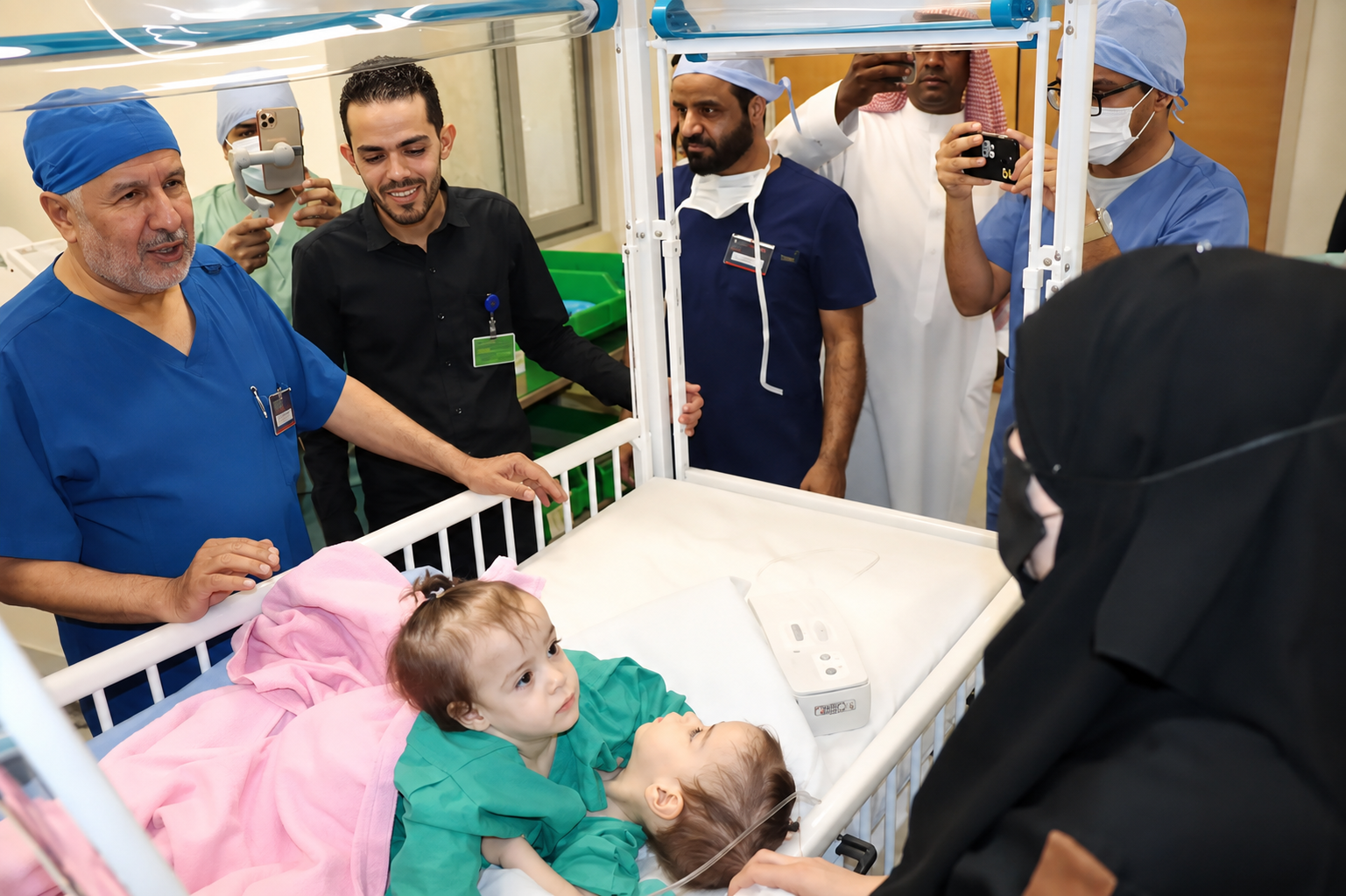
Saudi Arabia continues to strengthen its global position in the field of conjoined twin separation through the Saudi Conjoined Twins Programme, which has developed since its establishment in 1990 into one of the leading specialized medical and humanitarian programs dealing with rare and highly complex cases.
The program provides comprehensive care to conjoined twins referred from different countries, covering medical assessments and detailed examinations, surgical intervention and post-operative rehabilitation and follow-up. The Kingdom also covers the costs associated with treatment and care for eligible cases.
More than 35 years of medical expertise
Since its establishment, the program has treated and evaluated dozens of cases from around the world and carried out highly complex separation procedures requiring multidisciplinary teams and lengthy hours in the operating room.
Official data showed that by 2024, the program had evaluated 143 cases from 26 countries and successfully performed 61 separation surgeries. Its record continued to expand through 2025 and 2026, with the number of completed operations subsequently rising.
In April 2026, the Saudi Press Agency reported the successful separation of Filipino conjoined twins in a complex procedure, describing it as the 70th operation performed under the Saudi Conjoined Twins Programme. At that stage, the program had evaluated 157 cases from 27 countries.
In May 2026, Saudi medical teams achieved another milestone by successfully separating Tanzanian twins Nancy and Nice after a 16-and-a-half-hour operation conducted in 10 stages. The procedure was reported as the 71st separation performed under the program.
Highly complex surgical procedures
Conjoined twin separation requires extensive planning before surgery because the twins may be joined at different parts of the body and may share vital organs, blood vessels or other anatomical structures.
During the separation of Tanzanian twins Nancy and Nice, for example, 35 consultants and specialists from multiple disciplines participated in the procedure, including pediatric surgery, anesthesia, plastic surgery, urology and orthopedics. The complexity of the case required a highly coordinated multidisciplinary approach.
In April 2026, Saudi medical teams also successfully separated Saudi female conjoined twins during a six-and-a-half-hour operation carried out in six stages, involving 23 consultants, specialists, technical staff and nurses.
In June, the Saudi team successfully separated Filipino twins Olivia and Gianna in a six-hour procedure involving 22 consultants, specialists and nursing and technical staff.
Care beyond the operating room
The Saudi program’s role extends beyond the surgical procedure itself. Its comprehensive approach includes medical assessment, pre-operative preparation, surgery, post-operative monitoring and rehabilitation.
The program covers transportation, medical care, accommodation and other expenses for the twins and their accompanying family members, reflecting its humanitarian mission and its commitment to receiving cases from different parts of the world.
This integrated model enables medical teams to assess each case individually, determine whether separation is medically feasible and evaluate potential risks before developing a surgical plan tailored to the twins’ condition.
A global center for medical and humanitarian expertise
The Saudi Conjoined Twins Programme has become a model combining specialized medical expertise with a strong humanitarian mission, building more than three decades of experience in treating one of the world’s rarest and most challenging medical conditions.
Its continued successes have strengthened Saudi Arabia’s international standing in this field and helped establish Riyadh as a destination for families seeking specialized medical care and the possibility of separation surgery.
The program’s continued development reflects Saudi Arabia’s broader efforts to advance medical excellence and healthcare capabilities while maintaining its humanitarian commitment to patients facing rare and highly complex conditions.














