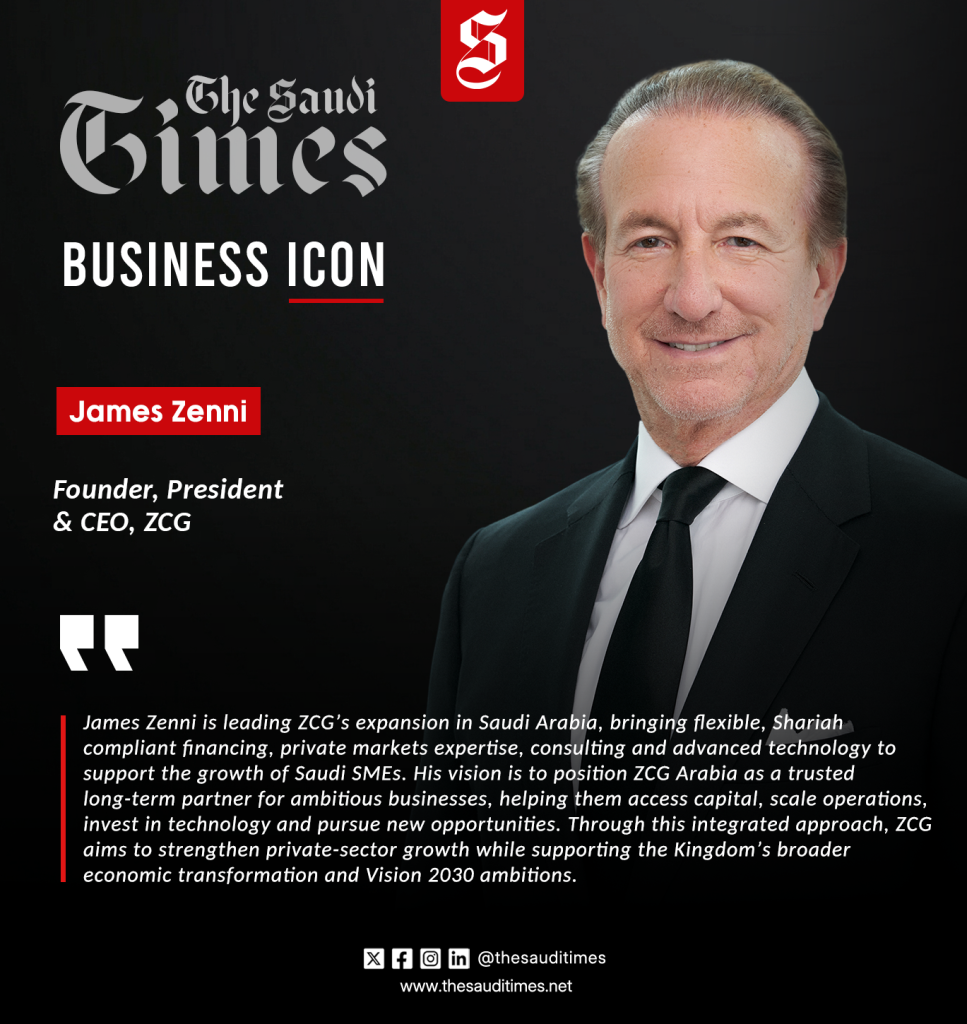
In an exclusive interview with James Zenni, ZCG’s Founder, President and Chief Executive Officer, The Saudi Times, Managing Editor, Abeer Abdalla deconstructs how the private sector will carry an increasingly significant share of the Kingdom’s economic transformation, and ZCG is betting that the next chapter will require more than abundant capital. It will require capital that understands how Saudi companies actually grow.
There is an interesting moment in the life of an economy when ambition stops being the scarce commodity.
Saudi Arabia may be entering it. For much of the first decade of Vision 2030, the global conversation around the Kingdom centered on the scale of its transformation: giga-projects, sovereign investment, tourism, technology, infrastructure and an unprecedented rewriting of the economic map.
The next stage is quieter, but potentially just as consequential. It is happening inside Saudi companies.
Small and medium-sized enterprises now contribute approximately 23 percent of Saudi GDP, according to figures cited by ZCG, against a Vision 2030 ambition of 35 percent by the end of the decade. Yet SME lending represents approximately 11.3 percent of total bank credit, compared with a national objective of 20 percent. ZCG estimates the resulting financing gap at more than SAR 300 billion.
That gap sits behind ZCG Arabia’s newest move in the Kingdom. The Riyadh-based platform of global private markets, consulting and technology firm ZCG has launched a CMA-regulated, Shariah-compliant SME direct financing platform, building on a Saudi presence that the firm describes as the product of years of market assessment, relationship building and planning.
For James Zenni, ZCG’s Founder, President and Chief Executive Officer, the decision is less an arrival in Saudi Arabia than a response to an economy that has already demonstrated what it can do.
“For us, it has never been about investing in an economy that’s finding its footing. It’s about committing to one that has already demonstrated its strength and whose ambitions continue to expand,” Zenni says.
It is an important distinction. International capital has spent years describing Saudi Arabia as an emerging opportunity. Zenni’s thesis is that the emergence has already happened.
The missing middle
The Saudi SME story is not simply about creating more companies. It is increasingly about what happens when those companies succeed. A business wins a larger contract. It needs working capital. A manufacturer wants another production line.
A healthcare company sees an acquisition opportunity. A technology business needs to scale faster than its existing financing structure allows.
Traditional banks remain central to that ecosystem, Zenni stresses, but the growing sophistication of Saudi companies creates room for additional forms of capital.
“This isn’t a reflection of a lack of opportunity. It’s a reflection of a rapidly growing economy where businesses are evolving and requiring a broader range of financing solutions,” he says. “Many fundamentally strong SMEs have reached a stage where they need additional financing sources to expand operations, invest in technology, pursue acquisitions, or finance working capital. Those needs don’t always fit within traditional bank lending frameworks.”
That is the territory ZCG Arabia wants to occupy. Its platform seeks to provide flexible, privately funded, Shariah-compliant financing tailored to individual companies rather than built around a standardized product.
The firm says its primary focus will include first-priority senior secured financing, revolving facilities using structures such as Murabaha, asset-based arrangements and other customized solutions. It is private credit translated into the commercial grammar
of the Saudi market.
Why now?
The timing is not only economic. Zenni points to changes in Saudi Arabia’s regulatory architecture, including the Bankruptcy Law and Civil Transactions Law, as important pieces of the institutional infrastructure supporting greater participation from private capital. He argues that these reforms have improved clarity around restructuring, creditor rights, commercial relationships and contractual enforcement, factors institutional investors scrutinize before deploying long-duration capital.
And then there is Vision 2030 itself. SMEs are not a peripheral subplot in the transformation program. Their expansion is integral to its employment, productivity, local-content and diversification ambitions.
“The Kingdom has made it clear that building a vibrant, diversified economy depends on empowering SMEs to innovate, create jobs, and contribute a larger share of GDP,” Zenni says. “Our objective isn’t simply to provide financing but rather to become a long-term partner to growing Saudi businesses.”
That language matters because ZCG is deliberately selling something broader than money.
Capital plus capability
ZCG’s global platform spans private markets asset management, consulting and technology. In Saudi Arabia, it intends to bring all three into the same relationship.
Through ZCG Consulting, or ZCGC, companies can access operational expertise. Through technology affiliate Haptiq, the firm brings AI-powered analytics and enterprise technology into underwriting and portfolio management.
Zenni describes both platforms as differentiators because they can be integrated throughout an investment lifecycle, from sourcing and underwriting to monitoring risk after the capital has been deployed.
This is where the model becomes particularly interesting. For decades, private capital has competed largely on cost, availability and structure. Increasingly, technology creates another variable: intelligence.
ZCG Arabia plans to use Olympus, Haptiq’s cloud-enabled platform, across the credit process. Zenni says the system assists with industry analysis, macroeconomic assessment, peer benchmarking and sector-specific performance indicators before a company even reaches detailed underwriting.
At company level, ZCG Arabia and ZCGC examine management, financial performance, cash generation, collateral, repayment capacity and a company’s position within its wider value chain. Olympus then applies a proprietary framework assessing more than 40 quantitative and qualitative factors across six areas: Financial Performance, Trends, Industry and Company Fundamentals, Collateral, Structure, and Other Risk Considerations.
The result is not an algorithm deciding whether somebody gets a check. Zenni is careful about that.
“We believe AI should enhance, not replace, decision-making,” he says.
Technology, in this model, is supposed to sharpen human judgment rather than substitute for it. Once financing has been extended, Olympus continues monitoring the portfolio through risk analytics, compliance reporting and watchlists designed to identify emerging issues earlier. That may sound technical. It is also central to the proposition. Private credit only works at scale when the discipline underneath the growth is as sophisticated as the ambition above it.
“Responsible financing isn’t a constraint, it’s the foundation of a successful private credit platform,” Zenni says.
A Saudi portfolio, not a Saudi sector ZCG Arabia says the financing strategy will be industry agnostic, but the areas Zenni highlights provide a map of where the firm sees momentum. Healthcare is one. Technology is another, including fintech, edtech, software-as-a-service and technology-enabled business models. Education, business services and tourism also feature prominently in the opportunity set.
What connects them is not trendiness. It is transformation. These are industries being reshaped by population growth, digitization, new consumer behavior, government investment and changing expectations of what a Saudi private company can become.
The firm says it will look for businesses with differentiated products or services, durable competitive positions, strong cash flows, resilient operations, experienced management and the ability to support first-priority secured financing.
In other words, ZCG is not looking merely for Saudi growth stories. It is looking for companies capable of surviving the scrutiny that accompanies institutional capital.
An ecosystem getting deeper
None of this happens in isolation. Saudi Arabia has spent years building institutional support for its SME economy through organizations including Monsha’at, Kafalah and SME Bank. ZCG Arabia is positioning itself as complementary to that architecture.
“Achieving the Kingdom’s Vision 2030 objectives will require collaboration among government programs, banks, and private capital providers,” Zenni says.
That may ultimately be the more important story behind the launch. The maturity of a financial market is not measured by the dominance of one source of capital. It is measured by choice. Banks. Government-backed programs. Institutional investors.
Private credit. Venture capital. Asset-backed financing. Shariah-compliant structures.
Different companies require different capital at different moments. Saudi Arabia’s diversification is creating not only more businesses, but increasingly complex businesses. The financing ecosystem around them must become equally sophisticated.
Riyadh as commitment ZCG’s Saudi strategy also extends well beyond SME lending. The firm says its Riyadh presence is intended to support activity across its private-market investment strategies, portfolio companies, consulting business and technology platform, alongside the new financing operation. “Establishing ZCG Arabia in Riyadh reflects our long-term commitment to Saudi Arabia and our confidence in the Kingdom’s future,” Zenni says. The firm plans to support the Kingdom through direct investment and portfolio company activity from its core private markets strategies, as well as services through its consulting and technology platforms.
That is increasingly the dividing line between companies merely entering Saudi Arabia and those trying to build within it. The former see a market. The latter build infrastructure.
What success looks like in 2030 There will be an easy way to measure ZCG Arabia’s expansion: capital deployed, but Zenni prefers a harder test.
“Success means becoming a trusted long-term financing partner for Saudi SMEs while helping mobilize additional private institutional capital into the Kingdom,” he says.
“If, by 2030, we’ve helped more businesses access flexible financing, supported sustainable private sector growth, and contributed to the objectives of Vision 2030 through this platform and the building of ZCG Arabia within the Kingdom more broadly, we’ll consider that a successful outcome.”
And that brings the story back to where Saudi Arabia finds itself today. Vision 2030 began with a state willing to imagine an economy differently. Its next test is whether thousands of individual Saudi businesses can turn that national ambition into balance sheets, factories, contracts, technologies, jobs, exports and companies capable of lasting beyond 2030 itself.
For those businesses, capital will matter. But increasingly, the intelligence, structure and patience attached to that capital may matter just as much.