By Abeer Abdalla | Managing Editor, The Saudi Times
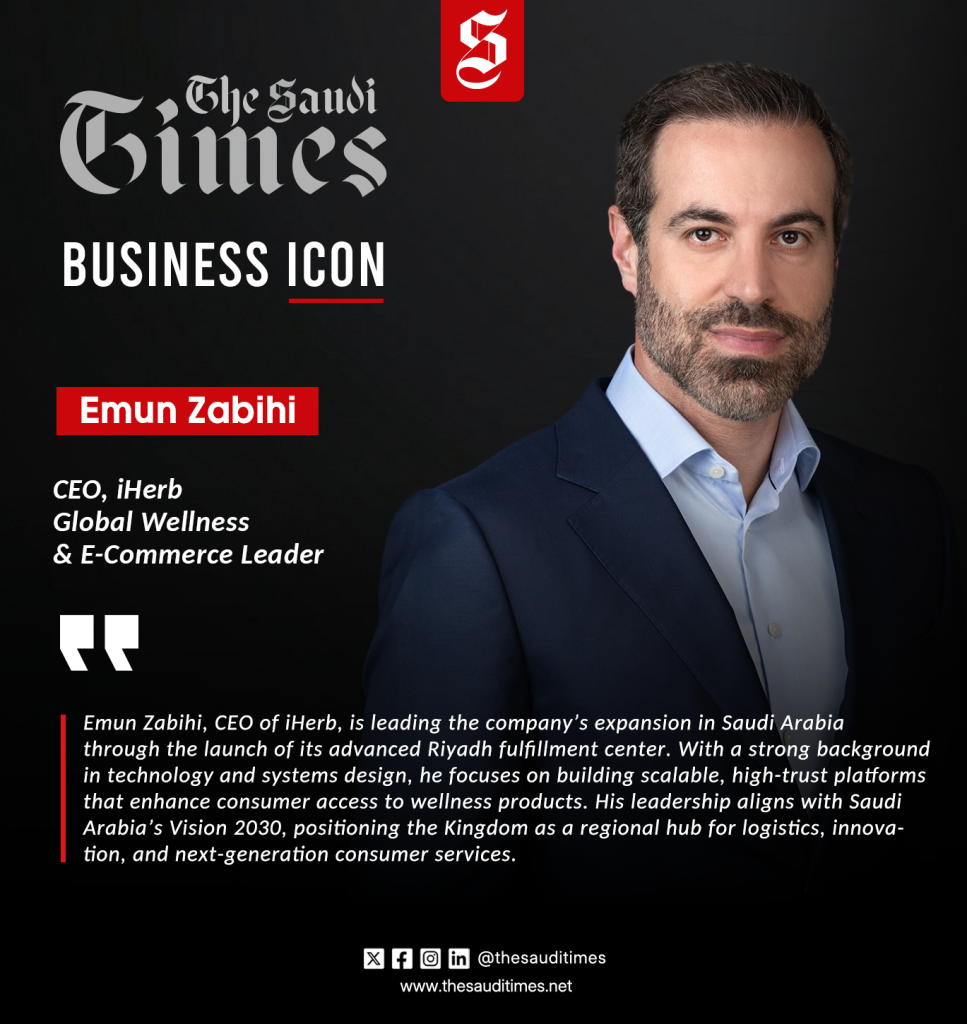
Saudi Arabia’s transformation is often told through giga-projects, diplomacy, and capital flows. But some of Vision 2030’s most consequential advances are taking shape more quietly through systems that improve everyday life at scale. That is where Emun Zabihi, CEO of iHerb, enters the Saudi story.
With the opening of iHerb’s Riyadh fulfillment center inside the Kingdom’s Special Integrated Logistics Zone, the company has done more than expand its footprint. It has embedded wellness into infrastructure. The site spans 40,000 square meters and operates with climate-controlled, cGMP-compliant handling in partnership with CJ Logistics, positioning wellness delivery as a matter of standards, reliability, and long-term service rather than simple retail convenience.
For Saudi Arabia, that matters.As the Kingdom advances its quality-of-life agenda and builds globally competitive logistics capacity, the infrastructure behind health products becomes part of the broader national transformation. Vitamins, supplements, and wellness goods are no longer peripheral lifestyle purchases. They increasingly sit within a consumer economy shaped by speed, trust, access, and regulatory confidence. In that context, iHerb’s presence in Riyadh reflects a larger market truth: Saudi Arabia is no longer merely a destination for demand. It is becoming a platform for regional fulfillment, operational excellence, and next-generation consumer service.
Building at the Intersection of Technology and Trust
Zabihi’s leadership trajectory helps explain why this move carries strategic weight. He joined iHerb in 2004 and rose through technology and product leadership before becoming CTO, then President, and ultimately CEO. His career reflects a model of executive leadership rooted not only in growth, but in systems design: building platforms that can scale globally while remaining responsive to local market expectations. That orientation is especially relevant in Saudi Arabia, where scale alone is no longer enough. Precision, localization, and trust are increasingly what separate serious operators from temporary entrants.
Under Zabihi, iHerb’s Riyadh facility signals a long-term operational commitment to the Kingdom. The decision aligns with a market shaped by a young, digitally fluent population, rising demand for wellness products, and a national logistics strategy designed to connect Saudi Arabia more competitively to regional and global trade.
Why Riyadh, Why Now
The logic behind the Riyadh center is not difficult to read. Wellness is becoming one of the defining economic and cultural categories of modern life. The global wellness economy has expanded into the trillions, making wellness not a niche category but a macroeconomic force with strategic implications for governments, investors, and operators alike.Saudi Arabia is particularly well positioned within that shift. The Kingdom is not only witnessing increased consumer interest in health, personal care, and preventative living. It is also building the physical and regulatory infrastructure that allows such demand to be served with speed and consistency. Riyadh’s logistics ecosystem was purpose-built to support exactly this kind of investment model: advanced supply chains, cross-border distribution, and globally benchmarked operating conditions.
That makes the iHerb facility strategically legible beyond one company. It demonstrates how Saudi Arabia is converting consumer demand into infrastructure. It also shows how global firms are beginning to treat the Kingdom not simply as a market to enter, but as a market in which to integrate.
Wellness as Infrastructure
The deeper relevance of Zabihi’s leadership is that it helps reframe wellness in practical terms. In Saudi Arabia today, quality of life is not an abstract policy slogan. It is increasingly measured through friction reduction: how quickly services move, how reliably products arrive, how well systems reflect local needs, and how confidently consumers can trust the standards behind what they buy.
That is where this story moves from logistics into national significance.
A fulfillment center may not sound glamorous. But in a country redefining how modern life is lived, built, and experienced, infrastructure is often where transformation becomes real. Proper storage, shorter delivery windows, stronger localization, and a more resilient supply chain all shape the lived experience of wellness. For millions of consumers, that is not back-end mechanics. That is the front line of daily life.
The Saudi Times View
Emun Zabihi represents a category of leader increasingly relevant to Saudi Arabia’s future: the executive who understands that scale without systems is noise, and that consumer trust is built operationally, not rhetorically. iHerb’s Riyadh expansion is therefore not only a commercial milestone. It is a signal that the Kingdom’s next chapter will be shaped as much by the quality of its delivery architecture as by the size of its ambition.
In Vision 2030 terms, that is the point. Modern nations are not judged only by what they announce. They are judged by what they make work. In Riyadh, Zabihi’s iHerb is helping make wellness work.
Published by Boudou Gueffai | Editor-in-Chief