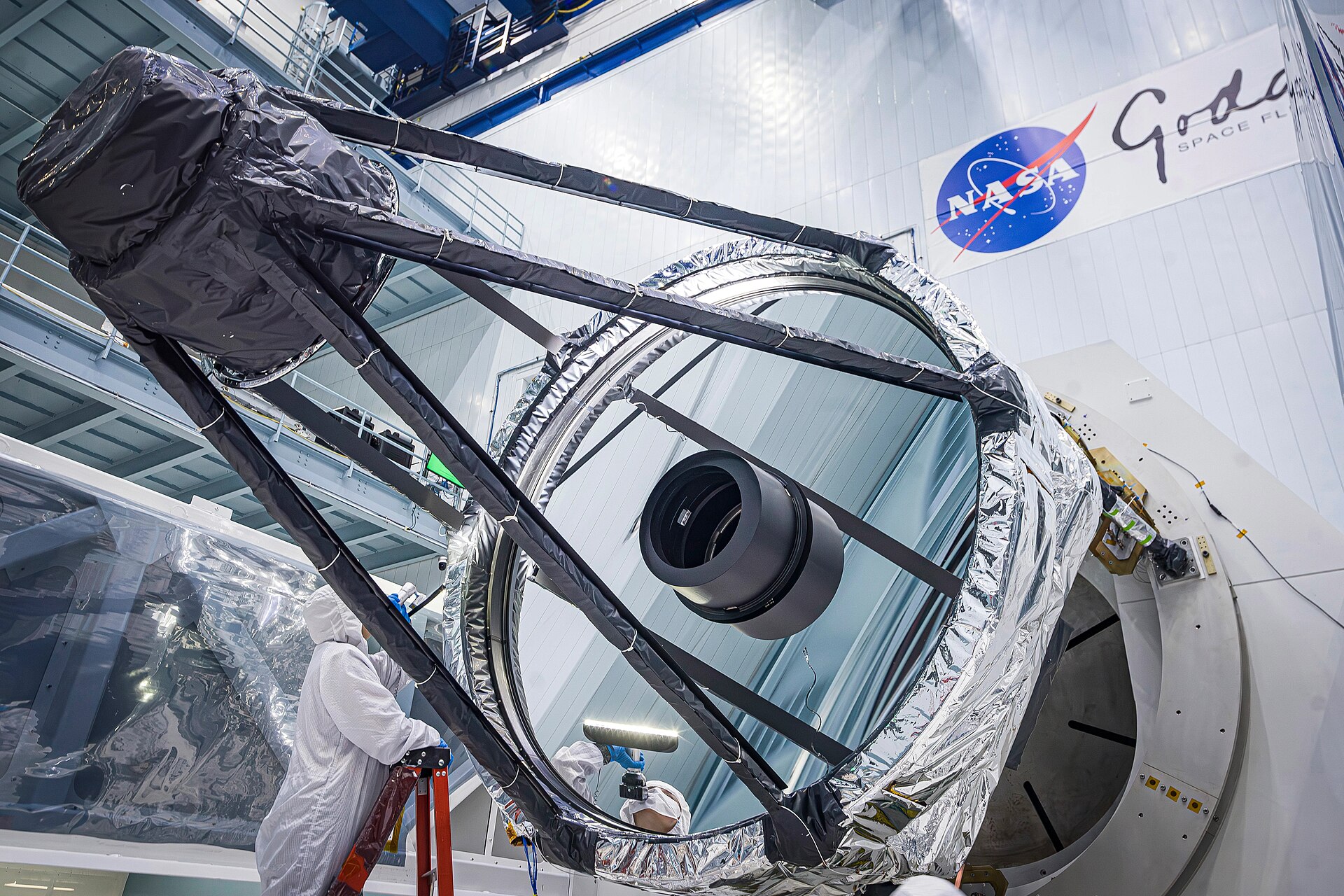
NASA's Nancy Grace Roman Space Telescope is producing sharper images than its own team planned for. Engineers at NASA's Goddard Space Flight Center in Greenbelt, Maryland, said on October 14 that the observatory's main camera, the Wide Field Instrument, is performing nearly 30% better than predicted after a very small adjustment to one of the telescope's mirrors.
After the final corrections, the team measured the instrument's optical error, a standard measure of image quality, at 63 nanometers RMS, against a requirement of about 90 nanometers. Roman launched on August 30 on a SpaceX Falcon Heavy rocket from Launch Complex 39A in Florida, and the Wide Field Instrument was switched on in September.
The correction was tiny. "We moved the secondary mirror by about one-sixteenth of the diameter of a human hair," said Alden Jurling, a senior optical engineer working on Roman at Goddard. NASA said that if the telescope were scaled up to the height of the Empire State Building, the change would be a little less than the height of a single US penny.
Some fine tuning in orbit was expected. "Our ground testing couldn't exactly reproduce the environment Roman would experience in space, such as the absence of gravity," said Matthew Bolcar, Roman's optical systems lead. The Wide Field Instrument carries 18 detectors, each about the size of a sticky note. "Calibrating an instrument is like tuning a piano or guitar before a concert," said Maxime Rizzo, a Wide Field Instrument systems engineer.
Roman's second instrument, the Coronagraph, first returned images that were slightly out of focus, though less than the team had expected, and the fix was relatively simple. Its performance now meets expectations, and the team plans to demonstrate its light-blocking capability in the coming weeks.
"All of the images from Roman's cosmic surveys will be even sharper than we expected," Jurling said. Dave Hickey, a Wide Field Instrument systems engineer, said "All of Roman's sweeping surveys will rely on the Wide Field Instrument."