


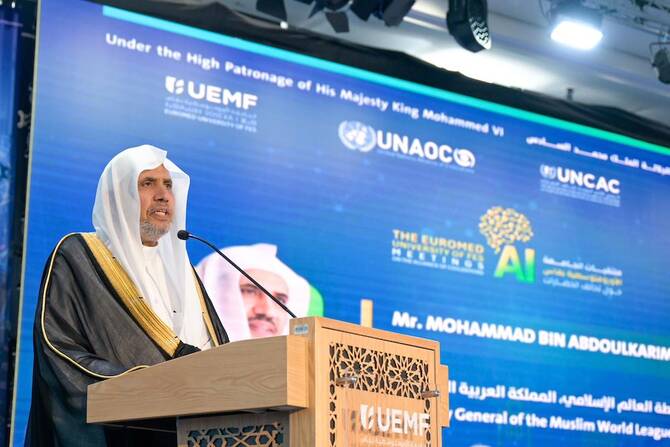
He made these remarks during his keynote speech at the international conference titled “The Future of Human Civilization in the Age of Artificial Intelligence,” held at the Euro-Mediterranean University of Fez in Morocco, which brought together more than 2,000 participants from 75 countries, including global officials, experts, and academics.
Al-Issa emphasized that the conference theme is central to understanding the evolution of human civilization and its intellectual transformation, noting that the world is currently experiencing a pivotal shift comparable to past scientific revolutions. He highlighted how machines have evolved from simple data storage tools into systems capable of analysis and idea generation.
He also pointed out that the foundations of the experimental scientific method were laid by Muslim scholars centuries ago, framing today’s AI revolution as a continuation of that intellectual legacy.
Al-Issa stressed that technological advancements must be guided by universal human values, warning against the risks of unregulated AI systems, especially in sensitive areas such as religion, race, and culture, where misuse could lead to division and conflict.
He called for clear ethical standards, greater transparency, and stronger accountability for companies operating in the AI sector, along with strict limitations on its use in high-risk domains, particularly those involving critical decision-making.
Reaffirming the importance of human oversight, Al-Issa stated that ultimate authority must remain in human hands, as AI systems are entirely dependent on the data they receive and lack independent awareness or free will.
He concluded by noting that technology ultimately reflects human choices and the values embedded by its creators.