



Sam Walton was one of the most influential entrepreneurs in the history of American business. As the founder of Walmart, he developed a retail strategy centered on low prices, operational efficiency, rapid expansion, and an intense focus on customers.
What makes Walton’s story remarkable is that his greatest success did not begin in Silicon Valley, New York, or another major business center.
Instead, he built his retail empire by focusing heavily on smaller American communities that many major retailers had overlooked.
The first Walmart opened in Rogers, Arkansas, in 1962, when Walton was 44 years old. Just five years later, the Walton family owned 24 stores generating $12.7 million in sales.
That early expansion became the foundation of a retail business that would eventually grow far beyond anything Walton could have imagined.
Sam Walton Age and Early Life
Samuel Moore Walton was born on March 29, 1918, in Kingfisher, Oklahoma.
He grew up during a period that included the Great Depression, an experience that helped shape his attitudes toward money, work, and financial discipline.
Walton learned the importance of earning money from an early age. His childhood included delivering milk from his family’s cows and selling magazine subscriptions.
The habits developed during these years remained visible even after he became extremely wealthy.
He became famous for maintaining a relatively modest lifestyle compared with the size of the fortune associated with his business success.
Forbes has noted that Walton continued driving an old Ford pickup even after Walmart had become a billion-dollar business.
Education and Early Career
Walton attended the University of Missouri, where he studied economics.
After graduating, he entered the retail industry and worked for J.C. Penney.
This early experience gave him exposure to store operations and customer service, but his ambitions eventually pushed him toward operating businesses of his own.
Following military service during World War II, Walton entered the variety-store business.
He operated a Ben Franklin franchise and began experimenting with ideas that would later become central to Walmart’s strategy.
He focused heavily on sales volume, competitive prices, customer service, and finding ways to operate stores more efficiently.
The Business Philosophy Before Walmart
One of Walton’s most important insights was that retailers could generate enormous businesses by selling products at lower margins while increasing sales volume.
Instead of attempting to maximize the profit earned from every individual item, his strategy focused on attracting more customers through consistently competitive prices.
This idea sounds relatively straightforward today.
At the time, however, it became part of a broader retail strategy that challenged established assumptions.
Walton also recognized an opportunity in smaller communities.
Many large retailers concentrated their expansion strategies around major urban markets.
Walton believed smaller towns could support successful discount stores if customers were offered attractive prices and sufficient product selection.
That strategy became one of Walmart’s most important early advantages.
Opening the First Walmart
On July 2, 1962, Sam Walton opened the first Walmart store in Rogers, Arkansas.
His central promise was simple: offer customers lower prices while maintaining good service.
Some competitors doubted whether the strategy could produce a sustainable business.
The results proved otherwise.
By 1967, the Walton family controlled 24 stores with annual sales of $12.7 million.
In 1969, the company was officially incorporated as Wal-Mart Stores, Inc.
Then came another critical milestone.
Walmart Goes Public
Walmart became a publicly traded company in 1970, initially selling shares at $16.50 each.
The capital generated through the public offering helped finance further expansion.
In 1971, Walmart opened its first distribution center and corporate home office in Bentonville, Arkansas.
By 1972, Walmart had 51 stores and $78 million in sales, and its shares were listed on the New York Stock Exchange.
The company was becoming much more than a regional discount retailer.
The Strategy Behind Walmart’s Growth
Walmart’s success cannot be explained by low prices alone.
Walton built a system designed to support those prices.
The company focused intensely on controlling costs, improving distribution, managing inventory, negotiating with suppliers, and increasing efficiency.
Scale became increasingly important.
As Walmart expanded, its purchasing power increased. Greater purchasing power could help the company obtain more favorable terms from suppliers, which supported its ability to maintain competitive prices.
Efficient distribution also became a major competitive advantage.
Rather than treating logistics as a secondary function, Walmart turned supply-chain efficiency into a central part of its business strategy.
The combination of scale, logistics, cost discipline, and pricing became extraordinarily difficult for smaller competitors to match.
Sam Walton’s Management Philosophy
Walton believed employees played a fundamental role in Walmart’s success.
He referred to workers as associates and sought to make them participants in the company’s growth.
Walmart’s own history credits Walton with sharing his vision with associates in ways that were unusual within the retail industry at the time and making them partners in the company’s success.
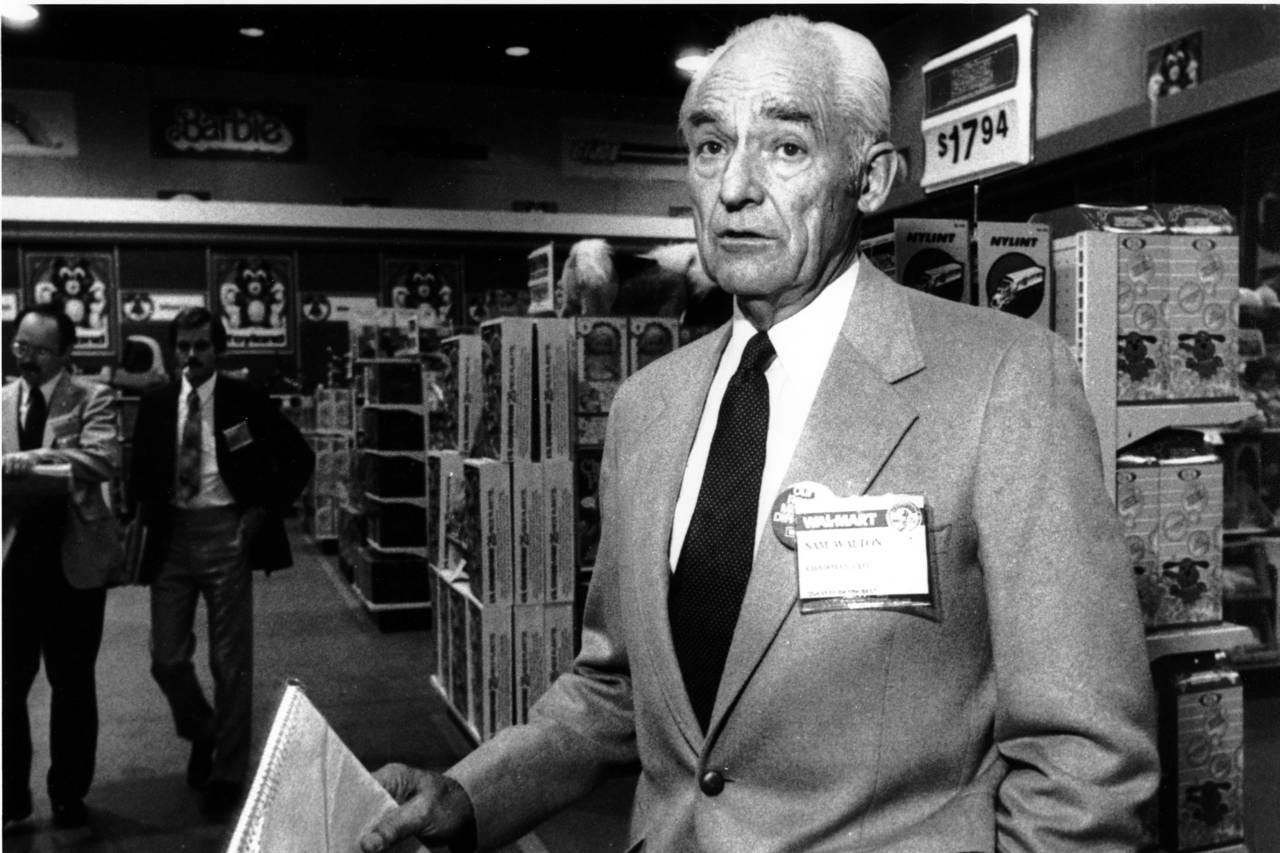
He was also known for visiting stores personally.
Rather than managing entirely from corporate offices, Walton spent considerable time observing stores, talking with employees, studying competitors, and looking for ideas that could improve operations.
This willingness to learn became an important part of his leadership philosophy.
He was famously willing to borrow successful ideas rather than insisting that every innovation had to originate inside Walmart.
Customer Obsession and Everyday Low Prices
At the heart of Walton’s philosophy was the customer.
His strategy was built around the belief that customers would reward retailers that consistently provided better value.
This ultimately became closely associated with Walmart’s emphasis on everyday low prices.
Instead of depending entirely on occasional promotions, the company sought to build a reputation around consistently competitive pricing.
That promise became one of the defining elements of Walmart’s brand.
But maintaining low prices required the entire organization to operate efficiently.
Warehouses, transportation, inventory systems, supplier relationships, store operations, and management all had to support the same objective.
Sam Walton’s Net Worth
Sam Walton became one of America’s wealthiest people as Walmart expanded.
Forbes named him America’s richest person in the 1980s, although Walton reportedly disliked the attention focused on his fortune rather than the company he had built.
Because Walton died in 1992, a modern “Sam Walton net worth” figure does not exist in the same way it does for living billionaires.
The scale of his financial legacy, however, is extraordinary.
In 2026, Forbes estimated the combined Walton family fortune at approximately $520 billion, making the Waltons America’s richest family. Much of that wealth remains connected to Walmart ownership.
This makes Walton’s legacy one of the largest examples of multigenerational wealth creation in modern business history.
The Walton Family and Walmart
Sam Walton and his wife Helen had four children: Rob, John, Jim, and Alice.
Ownership of Walmart eventually made several members of the family among the wealthiest people in the world.
Walton transferred substantial ownership to his children long before Walmart reached its eventual scale.
Today, his descendants remain major shareholders in the company.
The family has also expanded its interests into banking, philanthropy, art, environmental initiatives, education, and professional sports.
Despite Walton’s death more than three decades ago, the business he created remains the foundation of one of the world’s largest family fortunes.
Philanthropy and the Walton Family Foundation
Sam and Helen Walton established the Walton Family Foundation during Walmart’s rise.
The foundation became an important part of the family’s long-term philanthropic activities.
Over subsequent decades, Walton family philanthropy expanded into areas including education, environmental initiatives, and community development.
The family’s charitable activities have grown dramatically alongside Walmart’s value.
Forbes reported in 2026 that Walton family foundations had distributed billions of dollars to charitable organizations over the years.
Sam Walton’s Death
Sam Walton died on April 5, 1992, at the age of 74.
By that point, Walmart had already become an enormous American retailer.
His death, however, did not end the company’s expansion.
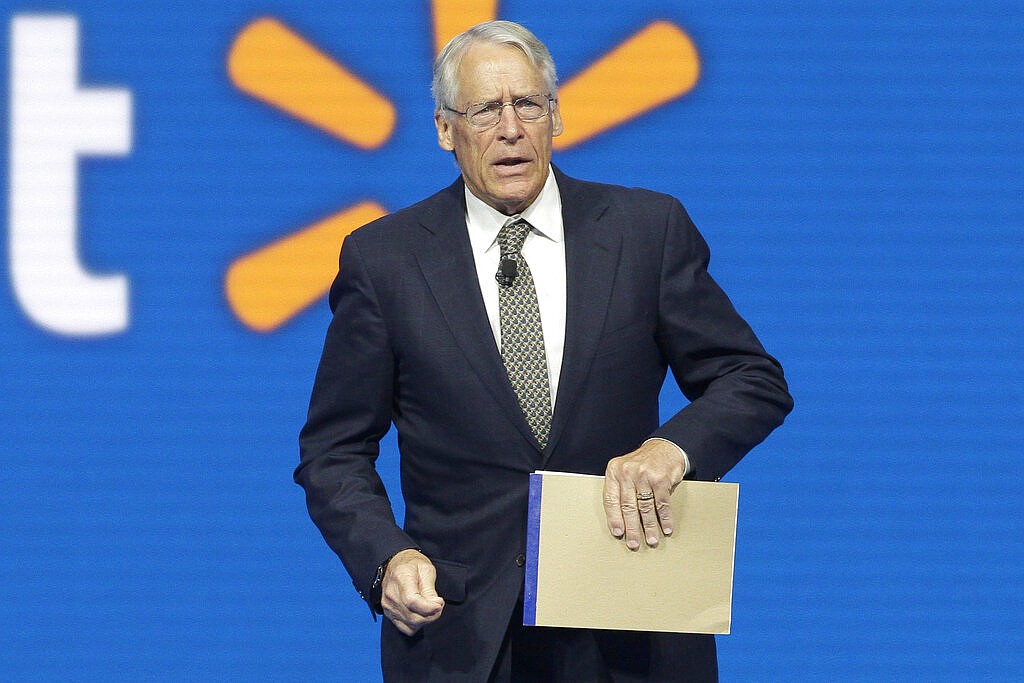
His eldest son, Rob Walton, succeeded him as chairman and remained in that role until 2015. The family continued maintaining significant ownership and influence over the retailer.
Walmart Decades After Sam Walton
Perhaps the clearest measure of Walton’s impact is what happened long after his death.
Walmart continued expanding across physical retail, grocery, international markets, logistics, and eventually electronic commerce.
In February 2026, Walmart became the first traditional physical retailer to reach a market capitalization of $1 trillion, according to Forbes.
That milestone arrived almost 64 years after Walton opened the first Walmart store.
It demonstrated the extraordinary durability of the business model he helped create.
Key Achievements
Sam Walton’s major achievements include:
- Founding Walmart and opening its first store in 1962
- Building a retail model centered on consistently low prices
- Recognizing the potential of underserved smaller communities
- Developing a culture focused on customers and operational efficiency
- Using distribution and scale as competitive advantages
- Taking Walmart public in 1970
- Building the foundation of what became one of the world’s largest retailers
- Creating a business that generated one of history’s largest family fortunes
His influence can be seen throughout modern retail, from supply-chain management and discount pricing to large-scale distribution and data-driven inventory operations.
Final Thoughts
Sam Walton’s story is fundamentally different from many of the technology entrepreneurs who came decades after him.
He did not invent a revolutionary device or create a new digital platform.
Instead, he took an existing industry and relentlessly improved the way it operated.
His innovation came from execution.
Lower prices, better logistics, disciplined costs, close relationships with employees, aggressive expansion, and constant attention to customers created a retail model capable of extraordinary scale.
Walton also demonstrated that transformative businesses do not necessarily have to begin in the world’s largest cities.
The first Walmart opened in Rogers, Arkansas.
From that beginning, Walton created the foundation of a company that would eventually become one of the most powerful businesses in global retail.
More than three decades after his death, Walmart’s enormous scale and the Walton family’s extraordinary fortune demonstrate how deeply Sam Walton’s ideas influenced modern commerce.
His legacy is therefore not simply the story of a wealthy businessman.
It is the story of how a relentless focus on price, efficiency, scale, and customers helped redefine global retail.