

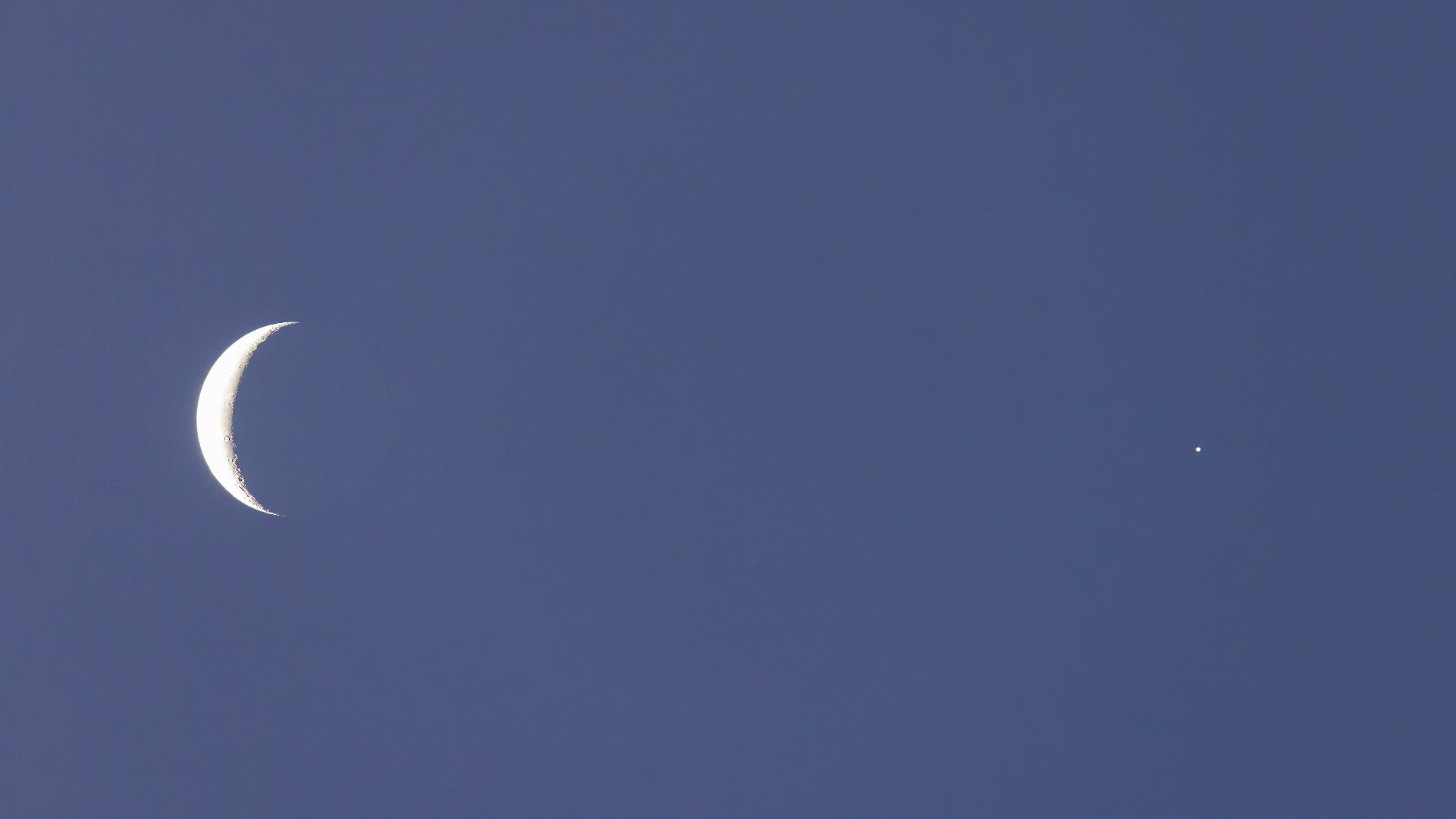
What did skywatchers in the Kingdom see this week? Before dawn on Tuesday, 3 November 2026, astronomy fans and photographers in Arar, in the Northern Borders region, watched the Moon and Jupiter shine side by side, the Saudi Press Agency reported. The pairing could be followed from many parts of the world.
Were the two really close to each other? No. Adnan Khalifa, a member of the Astronomy and Space Club, explained that a conjunction only means two objects look close from where we stand on Earth. In space, the Moon and Jupiter remain hundreds of millions of kilometres apart.
How near did they look? Calculations published by the Sky Tonight website put the closest point at about half a degree, roughly the width of the Moon itself, at around 1:46 am Makkah time on Tuesday. The Moon was waning, just past its last quarter, and both sat in the constellation Leo with Mars not far away.
Did you need a telescope? Not at all. Jupiter, the largest planet in the solar system, is bright enough to pick out with the naked eye, while binoculars or a small telescope reveal its larger moons. Khalifa noted that the open desert of the Northern Borders, with clear skies and little artificial light, makes a good place to observe.
Why did Jupiter not disappear behind the Moon? The Moon covered the planet completely only for observers in other regions, including parts of Southeast Asia, southern India and Australia. From the Kingdom, the event appeared as a close pairing without the planet being hidden.
When is the next chance? On Sunday night, 29 November, at about 11 pm, the Moon returns beside Jupiter, this time joined by Mars and Regulus, the brightest star in Leo, and the group stays in view until dawn on Monday. Jupiter will outshine Mars and Regulus at magnitude minus 2.2, the Moon will be about 60 percent lit, and all four can be seen without any optical aid.
Source: Saudi Press Agency, Ajel, Al Jazeera, Star Walk, Sky Tonight, Universe Magazine