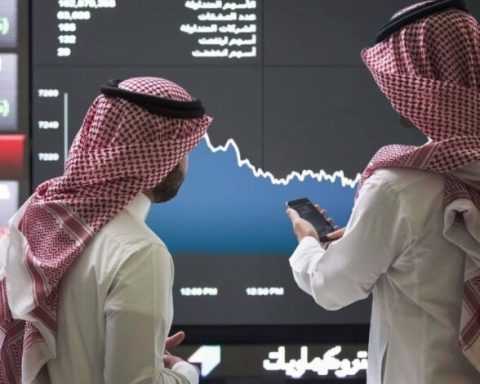


The International Monetary Fund has released its April 2026 World Economic Outlook, projecting Saudi Arabia’s economy to expand by 3.1 percent this year — a revision from the 4.5 percent forecast published in January — while upgrading the 2027 outlook to a robust 4.5 percent as conditions in the broader region are expected to normalise.
A Resilient Economy in a Challenging Region
Saudi Arabia’s revised growth figure of 3.1 percent for 2026 reflects adjustments to the IMF’s projections for the broader Middle East and Central Asia region, where the Fund cut overall growth expectations by roughly half to 1.9 percent for the year. Within that context, the Kingdom is positioned among the least affected economies, supported by the availability of alternative export routes and the depth of its economic diversification programs.
The IMF noted that Saudi Arabia — the Arab world’s largest economy and the world’s leading oil exporter — remains on a path of sustained expansion. The Fund’s upgrade of Saudi Arabia’s 2027 growth forecast, raised by 0.9 percentage points to 4.5 percent, reflects confidence that energy production and logistics activity will return to normal levels in the months ahead.
Vision 2030 as a Buffer
Saudi Arabia’s ongoing economic transformation under Vision 2030 has played a key role in reducing the Kingdom’s exposure to external shocks. The continued growth of non-oil sectors — including tourism, technology, entertainment, and financial services — has added new layers of resilience to an economy that once moved almost entirely in step with global oil prices.
The IMF’s projections also place Saudi Arabia ahead of several other Gulf states where growth is expected to contract in 2026. The Kingdom’s infrastructure investment pipeline, expanding private sector participation, and structural reforms have contributed to a more diversified growth base that insulates it from regional volatility more effectively than in previous cycles.
Long-Term Confidence Intact
Despite the near-term revision, economists and analysts tracking the Kingdom emphasise that the long-term investment narrative remains intact. Saudi Arabia has attracted record-breaking levels of foreign direct investment in recent years, and major giga-projects — from NEOM to the Red Sea Project — continue to move through their development phases, sustaining construction, services, and employment activity across the economy.
With the IMF projecting a return to 4.5 percent growth in 2027, the Kingdom enters the second half of the decade with strong structural momentum and a Vision 2030 framework that continues to position it as one of the most dynamic economies in the emerging world.