

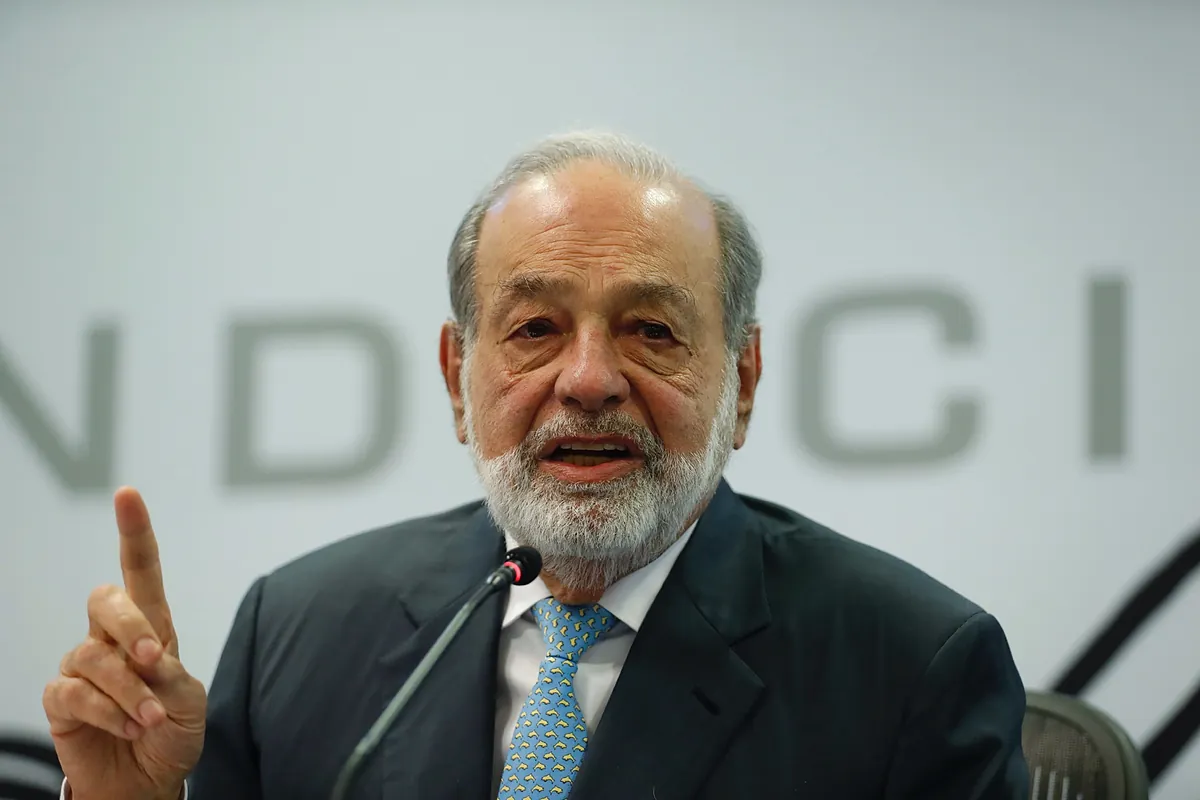
For decades, the Mexican businessman has accumulated businesses across telecommunications, retail, construction, infrastructure, banking, mining, energy, and real estate, creating an interconnected corporate empire whose influence extends throughout Mexico and far beyond it.
At the center of his business empire stands América Móvil, one of Latin America’s largest telecommunications companies.
But Slim’s business story is much broader than mobile phones.
Major interests are held through Grupo Carso, while other parts of his empire extend into financial services through Grupo Financiero Inbursa, infrastructure through IDEAL, real estate, mining, energy, and additional investments.
His career provides a different model of business building: not building one revolutionary startup, but repeatedly identifying undervalued assets, buying during difficult periods, improving businesses, reinvesting cash flows, and maintaining control for decades.

Engineering, Mathematics, and UNAM
Carlos Slim studied civil engineering at the National Autonomous University of Mexico, commonly known as UNAM.
His academic background is important because it helps explain his analytical approach to business.
While studying, Slim also taught algebra and linear programming at the university.
He was therefore simultaneously a student and a professor.
Engineering encouraged structured thinking.
Mathematics reinforced his ability to analyze numbers, costs, assets, and probabilities.
These skills later became central to his investment strategy.
Slim has never been known primarily as a charismatic product inventor.
His greatest strength has been capital allocation: understanding what an asset might be worth, comparing that value with its market price, and deciding where money can generate attractive long-term returns.
Building the Foundations of Grupo Carso
By 1965, he had begun building the foundations of what would eventually become Grupo Carso.
He established Inversora Bursátil and became Chairman of its Board.
He also began acquiring businesses and investing in real estate.
In January 1966, he established Inmobiliaria Carso.
The Carso name would eventually become attached to one of Latin America’s most important conglomerates.
From the beginning, Slim did not restrict himself to a single industry.
He invested in property, construction-related businesses, industrial companies, and financial assets.
Diversification would become one of the defining characteristics of his empire.
The Investment Philosophy That Built His Empire
One of the most important principles in Carlos Slim’s career is his willingness to invest when other people are afraid.
This became especially visible during Mexico’s economic crisis in the early 1980s.
The country faced a severe debt crisis.
Financial markets were under enormous pressure.
Businesses were struggling.
Capital was scarce.
Many investors wanted to reduce their exposure to Mexico.
Slim moved in the opposite direction.
Between 1982 and 1984, he continued investing aggressively.
His group acquired interests in companies including Reynolds Aluminio, Sanborns, General Tire-related operations, and other industrial and consumer businesses.
This became a defining pattern.
Slim understood that crises could temporarily push the prices of valuable assets far below their long-term economic potential.
Instead of attempting to predict exactly when a crisis would end, he focused on acquiring assets capable of surviving it.
Buying Businesses During Mexico’s Crisis
Slim’s acquisitions accelerated during the 1980s.
His group invested across insurance, manufacturing, retail, mining, tires, paper, tobacco, and other sectors.
Among the important developments was the acquisition of Seguros de México, which became part of what evolved into Grupo Financiero Inbursa.
Sanborns also became an important part of the expanding empire.
Mining assets, industrial manufacturers, and retail businesses were added over time.
The strategy was not random diversification.
Slim frequently targeted businesses with established assets, recognizable market positions, or the ability to produce recurring cash flows.
He could then use cash generated by mature businesses to finance investments elsewhere.
This created a compounding corporate ecosystem.
Grupo Carso Emerges
In 1980, the organization that would become Grupo Carso was established as Grupo Galas.
By 1990, it had adopted the Grupo Carso name and became publicly traded on the Mexican Stock Exchange.
Today, Grupo Carso describes itself as one of the largest and most important diversified conglomerates in Latin America.
Its businesses are organized around major areas including commercial operations, industry, infrastructure and construction, and energy.
The group has employed tens of thousands of people through its subsidiaries.
But the transaction that transformed Slim from a powerful Mexican businessman into a global business leader was still ahead.
The Telmex Deal
In 1990, Mexico began privatizing Telmex, the country’s state-controlled telephone company.
Slim participated in a consortium alongside Southwestern Bell and France Telecom that won the bid to acquire control.
The transaction became the defining deal of his career.
At the time, Mexico’s telecommunications infrastructure required enormous modernization.
Telephone penetration was limited compared with what would eventually become possible.
The internet revolution had barely begun.
Mobile communications were still in their early stages.
Slim saw telecommunications not simply as a telephone business, but as infrastructure for a rapidly changing economy.
Following the acquisition, enormous investments were directed toward modernizing the network.
Telmex became the foundation for the telecommunications empire that would eventually dominate Slim’s business interests.
Why Telecommunications Created Enormous Wealth
Telecommunications possesses several characteristics that can create enormous economic value.
Building a network requires huge initial investment.
But once the infrastructure exists, millions of customers can use it repeatedly.
Telecommunications services also generate recurring revenue.
Customers continuously pay for connectivity.
As economies digitize, demand for communications can increase rather than disappear.
Slim entered the sector before mobile phones and internet access became necessities for billions of people.
That timing was critical.
The value of owning telecommunications infrastructure increased dramatically as Latin America entered the digital age.
The Rise of Telcel
Alongside Telmex, Slim’s group developed its mobile telecommunications business.
Telcel became the dominant mobile brand in Mexico.
Mobile technology dramatically expanded the potential telecommunications market.
Fixed telephone networks required physical lines connecting individual homes and businesses.
Mobile networks offered a different path.
Millions of consumers who had never possessed traditional telephone service could enter the communications economy through cellular devices.
Slim’s companies recognized the opportunity early.
His official biography credits América Móvil with pioneering prepaid mobile service on a large scale in the 1990s, helping make cellular access available to a broader segment of the population.
Prepaid service was particularly powerful in markets where many consumers did not want or could not qualify for conventional monthly contracts.
Creating América Móvil
Slim’s telecommunications interests expanded far beyond Mexico.
América Móvil became the vehicle for building a pan-regional telecommunications empire.
The company expanded through acquisitions and investments across Latin America.
Operations grew in Brazil, Colombia, Argentina, Ecuador, Guatemala, El Salvador, and other markets.
The strategy created scale across countries rather than relying entirely on Mexico.
Today, América Móvil operates across the Americas and Europe and provides mobile, fixed-line, broadband, and other telecommunications services.
It became the central engine of Slim’s business empire.
Forbes describes América Móvil as Latin America’s largest mobile telecommunications company.

More Than América Móvil
It would be misleading to describe Carlos Slim simply as a telecommunications businessman.
Slim’s group has interests across telecommunications, banking and financial services, retail, industrial manufacturing, construction, infrastructure, energy, mining, real estate, hospitality, and consumer businesses.
The diversification helps explain the resilience of his businesses.
Telecommunications remains the most important pillar, but the group is not dependent on a single operating company.
Grupo Financiero Inbursa
Financial services represent another major part of the Slim ecosystem.
Grupo Financiero Inbursa includes businesses across banking, insurance, brokerage, investment, and related financial services.
Slim began building the foundations of the financial group decades ago through acquisitions including Seguros de México.
In 2025, Inbursa celebrated its 60th anniversary.
Financial services complement the rest of the business empire.
A group with major activities in infrastructure, industry, telecommunications, and real estate naturally interacts constantly with capital markets, financing, insurance, and investment.
Inbursa gives the group a major position inside Mexico’s financial system as well.
Infrastructure and Construction
Slim’s businesses also have major exposure to infrastructure.
Grupo Carso operates construction and engineering businesses, while IDEAL focuses on infrastructure development and related investments.
Infrastructure can include highways, transportation projects, energy facilities, water systems, and other large physical assets.
These businesses fit naturally with Slim’s long-term investment philosophy.
Infrastructure generally requires enormous upfront capital but can generate cash flows for many years.
It is therefore particularly attractive to investors willing to think in decades.
In May 2026, Slim announced that Grupo Carso and América Móvil planned to invest approximately $5 billion during the year across strategic sectors including infrastructure, oil exploration, and telecommunications.
His business organizations continue committing enormous amounts of capital to long-term projects.
Energy and Oil
Energy has become another increasingly important part of the broader Carso portfolio.
The group participates in energy-related businesses and has pursued investments connected with oil exploration and infrastructure.
This reflects Slim’s tendency to invest in sectors essential to economic activity.
Telecommunications connects people and businesses.
Infrastructure moves goods and supports cities.
Financial institutions allocate capital.
Energy powers the economy.
These sectors may lack the glamour of consumer technology startups, but they can create durable demand and enormous cash flows.
Real Estate
Real estate has been part of Slim’s investment strategy since the earliest years of his career.
He established Inmobiliaria Carso in the 1960s.
Over time, real-estate interests expanded across commercial properties, developments, shopping centers, offices, and other assets.
Property provides another form of diversification.
It also reflects Slim’s preference for tangible assets whose underlying economic value can survive periods of financial volatility.
The strategy resembles an important pattern visible among several multigenerational business groups: use cash generated by operating companies to acquire long-lived assets.
Sears Mexico and Retail
Slim’s empire also includes a significant retail presence.
Grupo Carso acquired control of Sears operations in Mexico during the 1990s.
The group also owns Sanborns, a distinctive Mexican retail and restaurant business with a history stretching back more than a century.
These businesses illustrate Slim’s willingness to own companies outside the usual high-growth sectors.
A mature retailer may not grow like a technology startup.
But if it has strong locations, recognizable brands, real estate, and predictable cash flow, it can still contribute substantial long-term value.
That principle appears repeatedly throughout Slim’s portfolio.
The New York Times Investment
Carlos Slim’s investment strategy has also extended outside Latin America.
One of his most prominent international investments was in The New York Times Company.
During a financially difficult period for the newspaper industry, Slim provided financing to the company and later accumulated a significant equity position.
Forbes notes that he previously held approximately 17% of The New York Times.
The investment was another example of a familiar Slim pattern.
A valuable organization encounters a period of uncertainty.
Market sentiment becomes negative.
Slim provides capital or acquires shares.
He then waits for the underlying value to develop.
Museo Soumaya
Museo Soumaya was established in 1994 and houses Slim’s extensive art collection.
Its collection contains more than 64,000 works, according to Slim’s official biography.
The museum includes Mexican and European art and is particularly famous for its collection of works by Auguste Rodin.
One of its most recognizable locations is the striking Plaza Carso building in Mexico City, designed by architect Fernando Romero.
The museum operates as a nonprofit institution and provides public access to a collection that would otherwise rank among the world’s most important private art holdings.
Carlos Slim Foundation
Philanthropy represents another major part of Slim’s legacy.
The Carlos Slim Foundation traces its origins to 1986.
Its programs have focused on areas including education, healthcare, nutrition, employment, digital inclusion, culture, sports, environmental initiatives, disaster assistance, and human development.
Grupo Carso says the Carlos Slim Foundation’s programs have reached more than 45 million beneficiaries.
Slim’s philanthropic philosophy often emphasizes building human capabilities rather than simply transferring money.
Education, health, training, connectivity, and employment are treated as tools that can expand people’s ability to participate in economic development.
Carlos Slim’s Business Philosophy
Several principles appear repeatedly throughout Slim’s career.
The first is to maintain financial discipline.
The second is to invest during crises rather than automatically retreat from them.
The third is to focus on the underlying value of businesses rather than short-term market sentiment.
The fourth is to reinvest cash flows.
The fifth is to maintain a long time horizon.
And the sixth is to remain diversified while still controlling important assets.
This philosophy explains why Slim’s empire looks so different from a typical startup founder’s company.
He did not make one bet.
He made hundreds of investments across decades.
Some were small.
Others transformed his career.
Telmex was the most important example.
But the underlying process existed long before telecommunications entered the picture.
Controversy Over Market Power
Slim’s extraordinary success has also generated substantial criticism.
The dominance of Telmex and Telcel in Mexican telecommunications has been the subject of regulatory scrutiny and long-running debates over competition.
Critics have argued that the scale of Slim’s telecommunications businesses gave them excessive market power and limited competition.
Mexican regulators introduced reforms intended to increase competition and reduce the influence of dominant telecommunications providers.
This is an important part of Slim’s legacy.
The same scale that created extraordinary efficiencies and wealth also created concerns about concentration.
His business career therefore illustrates one of the recurring tensions in modern capitalism: when does successful scale become excessive market power?
His Current Roles
Slim himself has stepped away from many corporate boards over the years.
His official biography notes that his current roles are increasingly concentrated around organizations including IDEAL and his philanthropic foundations.
This gradual transition is critical.
The true test of a business empire is not only whether its founder can build it.
It is whether the structure can survive after the founder stops making the major decisions.
Why Carlos Slim’s Story Is Different
Carlos Slim belongs to a different category of businessman from Elon Musk, Jeff Bezos, or Mark Zuckerberg.
He did not invent a revolutionary consumer technology.
He did not build a global social network.
He did not create an e-commerce platform from scratch.
His primary skill was capital allocation.
He studied businesses.
He bought assets.
He acquired companies during crises.
He restructured operations.
He reinvested profits.
And when he found an extraordinary opportunity in telecommunications, he invested at enormous scale.
In that sense, Slim’s career has more in common with Warren Buffett than with many technology founders.
But even that comparison is imperfect.
Buffett primarily built Berkshire Hathaway as an investment and holding company.
Slim built a network of operating businesses that became deeply embedded in the Mexican economy.
Key Achievements
Carlos Slim Helú’s major achievements include:
- Building the foundations of Grupo Carso in the 1960s.
- Investing aggressively during Mexico’s 1982 economic crisis.
- Creating one of Latin America’s largest diversified conglomerates.
- Participating in the acquisition of Telmex in 1990.
- Building Telcel into Mexico’s dominant mobile telecommunications brand.
- Expanding América Móvil across Latin America and Europe.
- Developing major businesses across finance, retail, construction, infrastructure, energy, mining, and real estate.
- Creating one of Latin America’s largest private philanthropic ecosystems.
- Building an art collection of more than 64,000 works housed through Museo Soumaya.
Final Thoughts
Carlos Slim Helú’s career demonstrates that great business empires are not always created by inventing something completely new.
Sometimes they are created by understanding value better than everyone else.
As a young engineer, he studied numbers and built businesses.
During Mexico’s financial crisis, while others were trying to escape risk, he acquired companies.
And when the Mexican government privatized Telmex, he recognized that telecommunications infrastructure could become dramatically more valuable as the country modernized.
But Telmex alone does not explain Carlos Slim.
His broader career is a story of buying, holding, reinvesting, diversifying, and compounding capital across more than six decades.
Telecommunications became the largest part of his business, but banking, retail, infrastructure, construction, energy, mining, and real estate helped build an empire far more diversified than a single company.
Carlos Slim proved that he could identify undervalued assets.
He proved that he could build enormous companies.
He proved that he could survive repeated economic crises.
The remaining question is whether the system he built can continue compounding capital when Carlos Slim himself is no longer at its center.
If it can, his greatest achievement may be building a business empire capable of lasting for generations.