


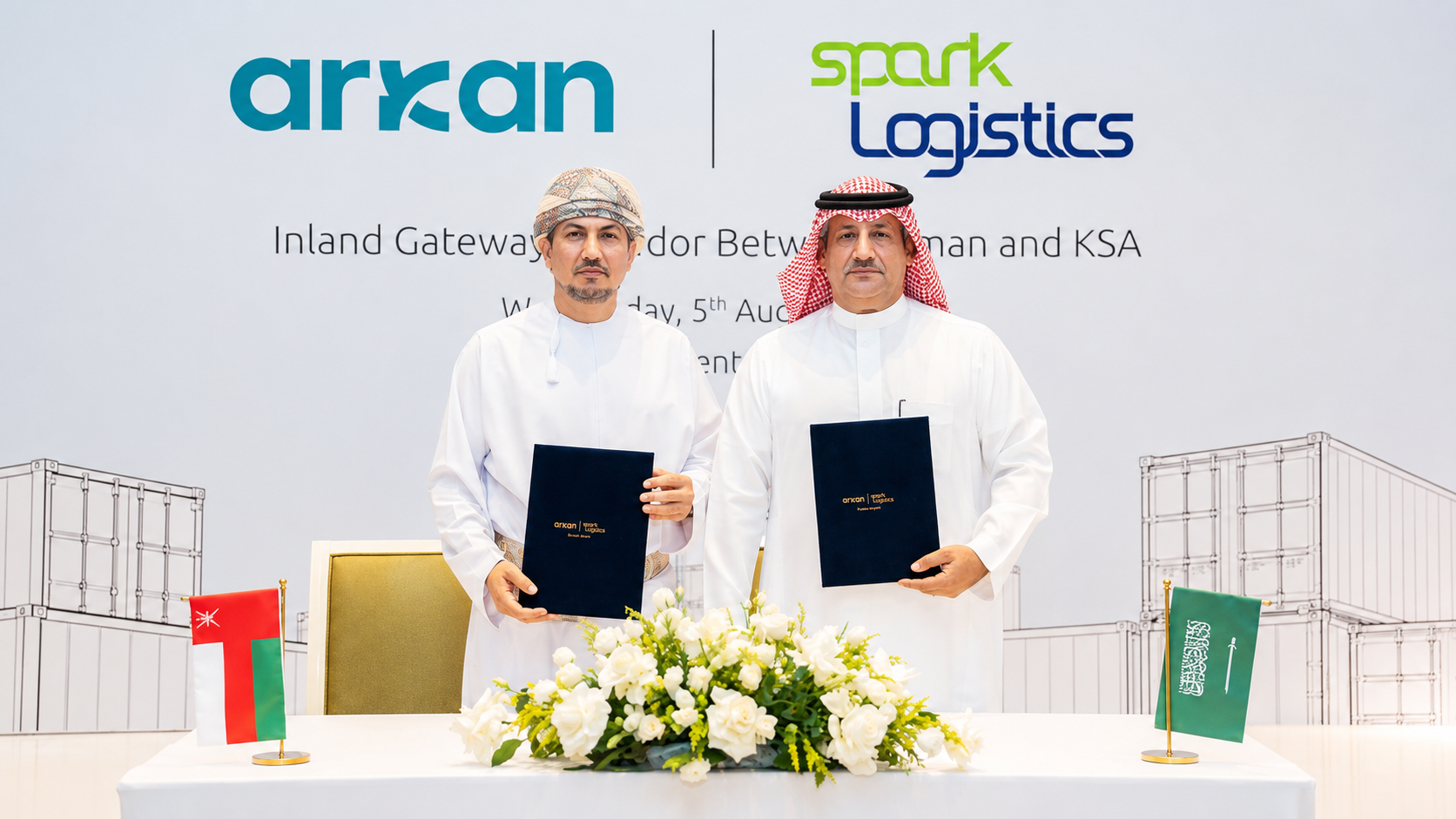
Saudi Arabia’s SPARK and Oman’s Arkan have signed a strategic partnership agreement to launch a land logistics corridor linking the Kingdom with Oman, in a move aimed at strengthening transit operations, improving freight transportation and enhancing supply-chain efficiency between the two countries.
The new corridor is expected to increase the flow of goods between Saudi and Omani markets, reduce transportation times and costs, and support the expansion of warehousing, distribution and logistics services on both sides of the border.
Empty Quarter Road Strengthens Connectivity
The logistics corridor will build on the road network connecting Saudi Arabia and Oman through the Empty Quarter, one of the most significant land-link projects between the two countries.
The road stretches approximately 564 kilometers from the Al-Batha-Haradh intersection to the Empty Quarter border crossing, with construction costs reaching around SR2 billion.
The project involved extensive engineering work to overcome the challenging desert environment, including large-scale sand removal, protective layers and asphalt works, as well as the installation of safety infrastructure and facilities designed to support vehicle and truck traffic.
A New Route for Regional Supply Chains
The importance of the project extends beyond facilitating truck movements between Saudi Arabia and Oman. The corridor is also expected to strengthen private-sector access to regional markets and improve connectivity between border crossings and commercial centers.
It could also support the growth of logistics-related services, including warehouses, distribution centers, freight stations and truck-support facilities, creating new opportunities for investment across the logistics sector.
The initiative comes amid growing trade and logistics integration between Saudi Arabia and Oman, with land transportation playing an increasingly important role in supporting regional trade and supply chains.
Supporting Saudi Arabia’s Logistics Strategy
The development of land corridors is aligned with Saudi Arabia’s National Transport and Logistics Strategy, which seeks to strengthen connectivity across domestic, regional and international transport networks and establish the Kingdom as a global logistics hub.
The strategy also targets increasing the contribution of the transport and logistics sector to GDP from around 6 percent to 10 percent, while expanding the sector’s non-oil revenues as part of the Kingdom’s Vision 2030 objectives.
The new Saudi-Omani corridor is expected to add another important link to the region’s land-transport network, providing a more integrated route for freight movement while improving transit efficiency and supporting bilateral trade.