
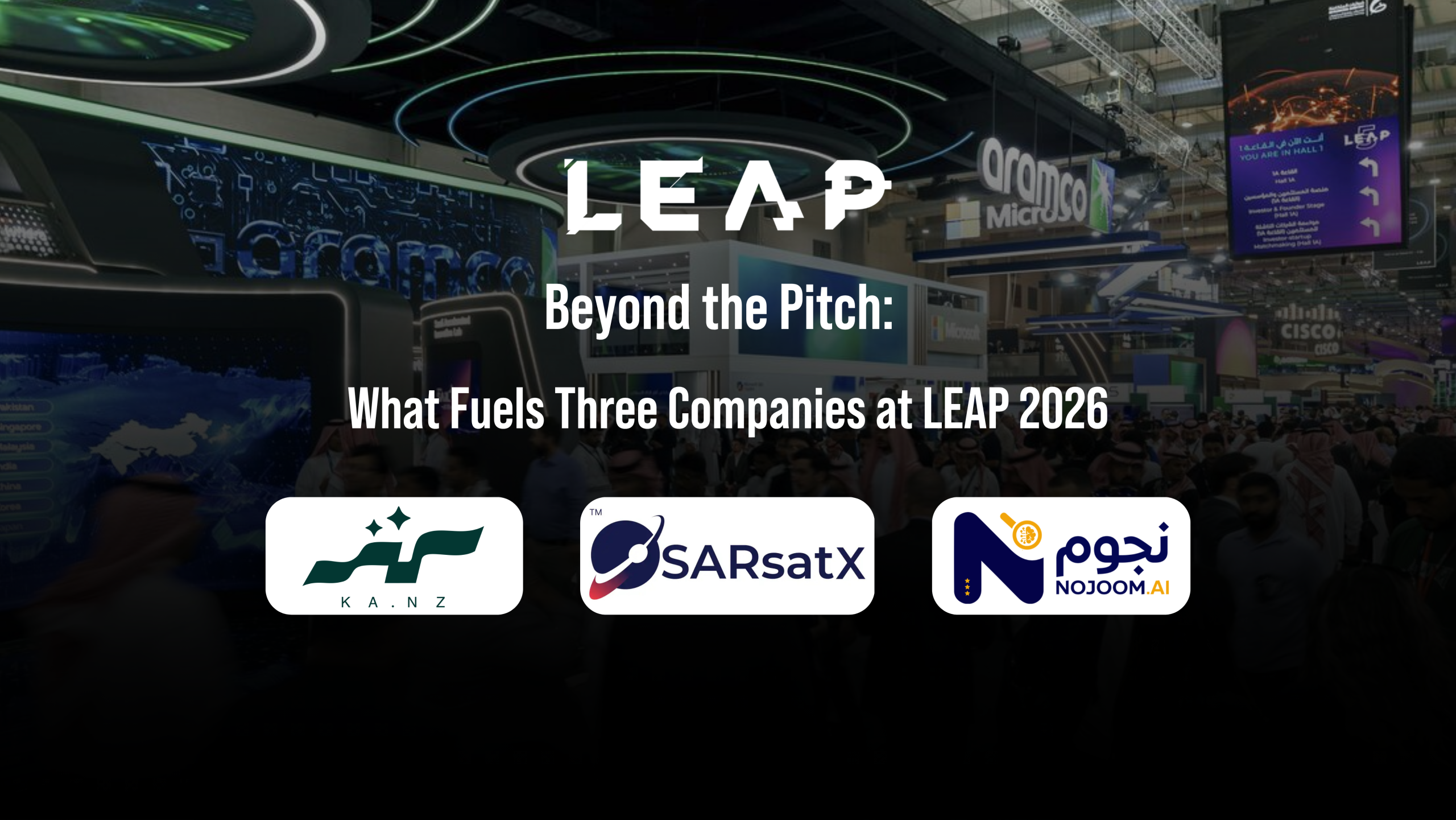
Rocket Fuel brings 100 startups into a $1 million equity-free competition. The Saudi Times follows SARsatX, Kanz and NOJOOM.AI to examine what they want to build, who they need to meet and why Riyadh matters.
By Abeer Abdalla, Managing Editor, The Saudi Times
At most startup competitions, the pitch is the climax. At LEAP’s Rocket Fuel, it is the opening move. Founders arrive with three minutes to explain a company, but they enter a Saudi ecosystem capable of supplying something far more consequential than applause: customers, capital, public-sector access, industrial partners and a market being rebuilt at national scale.
Rocket Fuel is LEAP’s flagship startup competition. In 2026, 100 semifinalists representing more than 40 nationalities and 25 countries competed across three days. Ten advanced to the Main Stage finale, where seven winners share a $1 million equity-free prize fund spanning the LEAP, Shooting Star, Scaling Star, Into New Worlds, Tech for Humanity, LEAP Landing and People’s Choice awards.
The structure matters because it evaluates more than performance under stage lights. Startups are scored on innovation, potential, functionality, market traction, social impact, team strength and delivery. The deeper test comes afterward: whether a conversation becomes a pilot, an introduction becomes an investment, or a visiting founder chooses Riyadh as the place to build the next chapter.
That possibility is grounded in economic momentum. Saudi Arabia attracted a record $1.72 billion in venture capital across 257 deals in 2025, while the digital economy contributed 16 percent of GDP and the ICT market reached SAR 199 billion. Vision 2030 has aligned regulation, infrastructure, investment and national demand in a way that few startup ecosystems can reproduce. Other markets can offer a prize. Saudi Arabia can offer a mandate.
What Fuels the Founder?
The Saudi Times set out to follow that mandate through a more human question: What fuels the founder? Rather than covering Rocket Fuel only as a contest, this series looked at the people behind three companies, what they are trying to change and which connections at LEAP could unlock their next stage. Their answers reveal three distinct but interconnected ambitions: sovereign intelligence from space, an AI-ready workforce and Arabic technology built on its own foundations.
SARsatX: Sovereign Intelligence From Orbit
SARsatX is building a sovereign Saudi space capability from orbit to decision. The company designs, develops and operates Earth-observation satellites using Synthetic Aperture Radar and optical sensors, then converts imagery into operational intelligence through its EarthLife platform. Its applications extend across government, energy, agriculture, mining, maritime monitoring, infrastructure and disaster response, where visibility in darkness, cloud or difficult weather can change the quality and speed of a decision.
Led by co-founder and CEO Amru Alamoudi, SARsatX brings more than two decades of aviation and space experience into a company focused on local manufacturing and global relevance. In his response to The Saudi Times, Alamoudi said what fuels him is “building something from Saudi Arabia that can compete globally while contributing to the development of a strong Saudi space ecosystem.”
At LEAP, Alamoudi is seeking senior decision-makers, strategic partners and investors across technology, defense, energy and investment who can accelerate adoption of SARsatX’s Earth-observation technology internationally. He wants connections that yield partnerships, customers, investment and technology collaboration, not introductions alone.
Kanz: Turning AI Access Into Workforce Capability
Kanz approaches national capability from the ground rather than orbit. Its AI-powered platform connects Saudi talent with employers, but founder Roy Baladi’s larger argument is that workforce transformation cannot stop with better matching. Workers must also be able to build with AI, demonstrate what they know and carry visible proof of that capability into the labor market.
That philosophy powered an eight-day AI training hackathon that drew 51,693 registrations from 170 countries. A single lesson brought together 14,075 participants and secured a Guinness World Records title. The scale is impressive, but Baladi sees it as a foundation rather than a finish line. “What I truly want now is to bring this technology home,” he told The Saudi Times. “Our region is perfectly capable of leading with it.”
At LEAP, Baladi wanted meetings with corporate chief executives, ministry leaders and decision-makers capable of extending AI enablement across entire organizations and populations.
NOJOOM.AI: Building Arabic Intelligence Natively
NOJOOM.AI makes the sovereignty question linguistic. Led by Dr. Mourad Bouache, the company is building native Arabic generative AI infrastructure rather than adapting English-first systems after the fact. It used LEAP to introduce AQL-42B, its proprietary foundation model, and to pursue enterprise partners in banking, healthcare and government that require secure, private and locally relevant Arabic agents.
Bouache described the goal to The Saudi Times as “moving 450 million native Arabic speakers from being passive consumers renting fragmented foreign AI to becoming true architects and owners of their digital intelligence.”
The company says its native architecture reduces the token inefficiency and grammatical distortion Arabic users can encounter in global models. It is also establishing its regional headquarters and delivery hub in Riyadh, seeking sovereign cloud partners, research bodies, Saudi investors and institutions prepared to co-build rather than simply buy.
Three Systems, One Saudi Proposition
Placed together, the three companies map the real breadth of Vision 2030’s technology proposition. SARsatX turns space infrastructure into sovereign insight. Kanz turns AI access into workforce capability. NOJOOM.AI turns Arabic from a secondary interface into a primary computational language. One looks down from orbit, one builds capacity across society and one works inside the architecture of language itself.
This is what Rocket Fuel makes visible. Its $1 million fund is meaningful, but the larger prize is entry into a coordinated market where government ambition, private capital, enterprise demand and founder talent can meet in the same week. Saudi Arabia is not asking innovators to watch the transformation. It is asking them to participate in its construction.
As a media partner of LEAP 2026 and the exclusive media partner for Rocket Fuel, The Saudi Times is honored to document that journey. The responsibility is not only to report who advanced or who won, but to follow what happens after the pitch: the partnerships formed, the headquarters opened, the talent trained and the technologies deployed. Rocket Fuel may end on a stage. Its most important stories begin when the founders step off it.