By Abeer Abdalla | Managing Editor, The Saudi Times
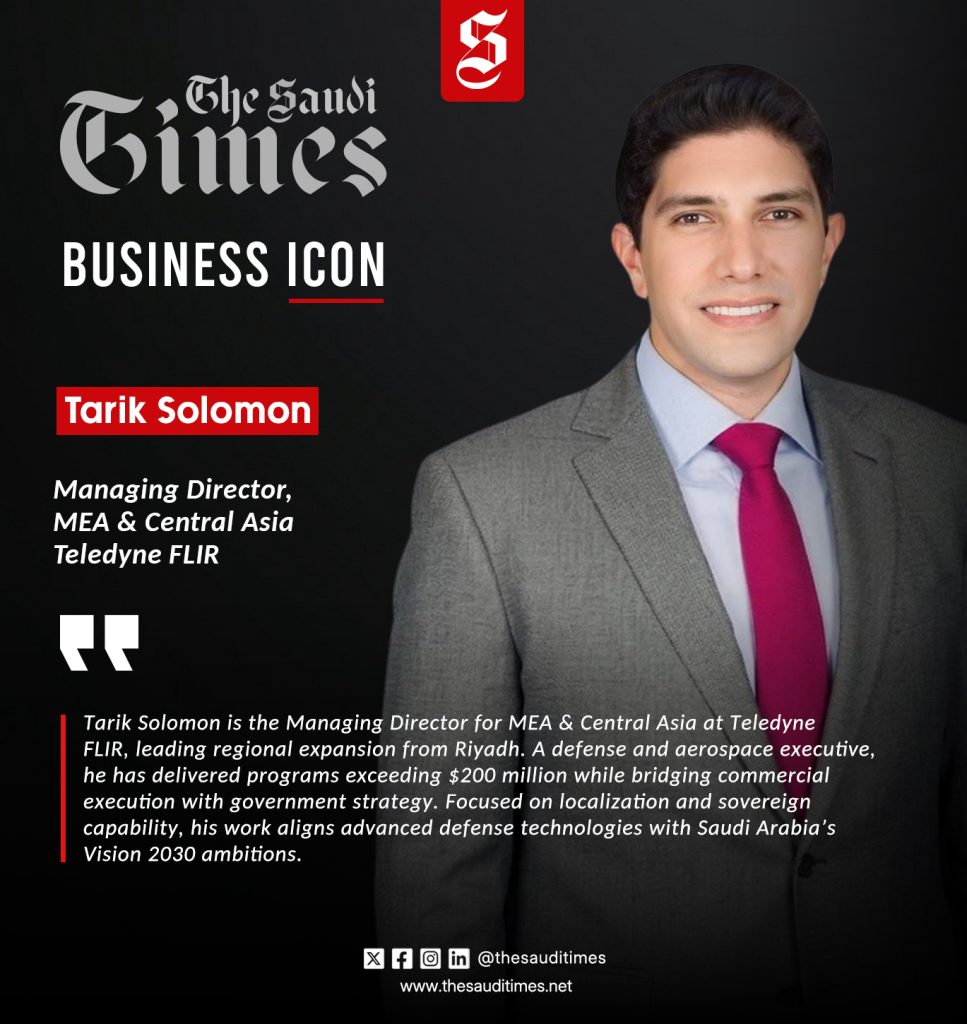
Tarik Solomon did not arrive in Riyadh to sell a product. He arrived to build a presence.
In November 2025, Teledyne FLIR Defense appointed Tarik Solomon as Managing Director for the Middle East, Africa, and Central Asia based in the Saudi capital. Alongside the announcement, the company confirmed it had secured its Regional Headquarters license in Saudi Arabia, with a formal Riyadh office set to open by mid-2026. The moves were deliberate and sequential. In a market that now asks multinational defense firms to show roots, not just revenue, they signal intent, and a commitment to strengthening the Kingdom homefront.
A Career Built at the Intersection of Industry and Strategy
Solomon’s distinction lies in his ability to operate across three layers that are often separated in practice: commercial execution, government and institutional engagement, and long-term industrial strategy. According to the American Chamber of Commerce Saudi Arabia, where he previously served as Chairman, he has spent his career delivering defense and aerospace programs exceeding $200 million across land, sea, and air platforms. His client and partner roster spans Collins Aerospace, L3Harris, Raytheon, and Frequentis, names that trace the architecture of Western defense supply chains. That combination is rare in a sector where technical credibility alone is not enough, and where industrial success increasingly depends on the ability to align corporate objectives with national priorities.
Before joining Teledyne FLIR, he served as Executive Director at Arabian Sahara Company and led operations and strategy at UnmannedX, an unmanned systems firm. He also holds board positions with the Middle East Policy Council in Washington and the regional board of Duke University’s Fuqua School of Business, networks that matter in a sector where procurement decisions, human capital development, and policy direction rarely travel separately.
His background gives him an unusual advantage in a market where success depends not only on technical credibility, but on the ability to translate between Western corporate systems and Saudi strategic priorities without losing momentum on either side.
What Riyadh Is Actually Asking For
Saudi Arabia’s Regional Headquarters program has reshaped expectations for multinationals entering the market. Launched to draw companies away from legacy Gulf hubs and toward Riyadh as a genuine decision-making center, the program had attracted more than 600 international firms by 2025, surpassing its original 2030 target ahead of schedule.
The bar for entry is not symbolic. Companies that establish RHQ status in Riyadh are expected to localize operations, develop local talent, build supplier relationships within the Kingdom, and contribute to sectors aligned with Vision 2030 priorities. Defense and advanced technology sit near the top of that list.
Teledyne FLIR’s structure under Solomon reflects this directly. The company has stated plans for integrated regional supply chains and indigenous research and development in artificial intelligence, autonomy, and data analytics. Saudi manufacturers, technology firms, and universities are identified as potential partners for joint R&D and workforce development. These are not aspirational talking points. They map onto formal government frameworks, including the National Industrial Development and Logistics Program, which provides grants, tax incentives, and R&D support for companies building local content.
“Beyond import and integration,” Solomon said in Teledyne FLIR’s announcement, describing a goal of building interconnected regional capability rooted in sovereign technology development and economic diversification.
Localization as the Real Mandate
The phrase captures something that has shifted in how serious defense firms now engage with the Kingdom. Saudi Arabia is no longer a market that buys finished systems and absorbs the technology. It is a market that expects to own a growing share of the value chain, from applied research to systems integration to industrial production.
Localization, in practice, means sourcing sensor components and subsystem production from Saudi manufacturers, bringing logistics and quality assurance processes onshore, and co-developing prototypes with Saudi universities and defense research bodies. It means intellectual property that carries Saudi fingerprints, not just Saudi-destined revenue.
Solomon’s background positions him to execute on exactly that model. His experience spans commercial delivery, government relations, and institutional partnership. In Saudi Arabia, where the lines between industrial policy, diplomacy, and national strategy converge more visibly than in most markets, that combination is the job.
A Broader Signal
Teledyne FLIR’s Riyadh footprint is one data point in a larger pattern. The city is becoming the primary address for companies that want to shape their regional strategy rather than simply service a territory. Executives based in Riyadh with genuine operational authority are no longer an anomaly. They are increasing the expectation.
For the Saudi defense and technology sector, Solomon’s appointment reflects where the market has moved. Advanced capability, long-term partnership, and local integration are the criteria. Companies that show up with those credentials in place, and executives who can deliver on them, are the ones getting taken seriously.
Solomon is one of them.
Published by Boudou Gueffai | Editor-in-Chief | The Saudi Times