

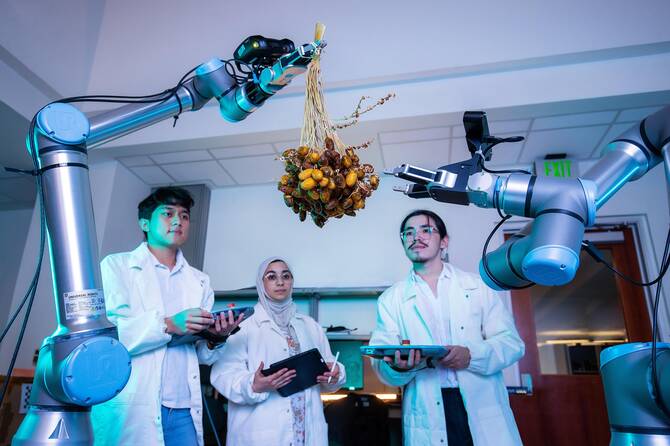
King Abdullah University of Science and Technology (KAUST) researchers have unveiled a revolutionary agricultural technology that enables highly efficient food production in desert environments using 90 percent less water than traditional farming methods, potentially transforming agricultural practices across arid regions worldwide.
The groundbreaking system combines advanced solar panel technology with innovative water recycling mechanisms, atmospheric water generation, and precision agriculture techniques to create a completely sustainable farming solution designed specifically for extreme desert conditions. Initial trials have demonstrated remarkable success in producing high-quality vegetables, fruits, and grains in Saudi Arabia’s harsh climate.
Dr. Fatima Al-Zahra, lead researcher on the project and director of KAUST’s Desert Agriculture Innovation Center, explained that the technology addresses critical food security challenges facing Saudi Arabia and other arid nations. The system’s ability to operate independently of traditional water sources makes it particularly valuable for remote communities and regions with limited water access.
The solar-powered system incorporates cutting-edge photovoltaic technology that generates sufficient electricity to power all agricultural operations, including water processing, climate control, and automated farming equipment. Excess energy is stored in advanced battery systems, ensuring continuous operation during nighttime hours and periods of reduced sunlight.
Water efficiency represents the technology’s most significant innovation, utilizing atmospheric water generation, advanced filtration systems, and closed-loop recycling to minimize water consumption while maximizing crop yield. The system captures moisture from desert air, processes it into high-quality irrigation water, and recycles all water used in the growing process.
Field trials conducted across multiple locations in Saudi Arabia have demonstrated the system’s versatility and effectiveness in various desert conditions. Crops grown using this technology have shown superior nutritional content, longer shelf life, and resistance to common agricultural pests and diseases that typically affect desert farming operations.
The economic implications of this agricultural breakthrough are substantial, with potential applications spanning food security enhancement, rural economic development, and export opportunities for agricultural products grown in previously unusable desert lands. Early economic analysis suggests that the system could pay for itself within three years through crop sales and reduced water costs.
International development organizations have expressed significant interest in deploying this technology across Africa, the Middle East, and other arid regions where food security remains a critical challenge. Preliminary agreements are being negotiated for technology transfer and implementation programs in several countries.
The research project received substantial funding from Saudi Arabia’s National Science and Technology Program, demonstrating the Kingdom’s commitment to developing innovative solutions for sustainable agriculture and food security. Additional support from international research partnerships has accelerated development and testing phases.