


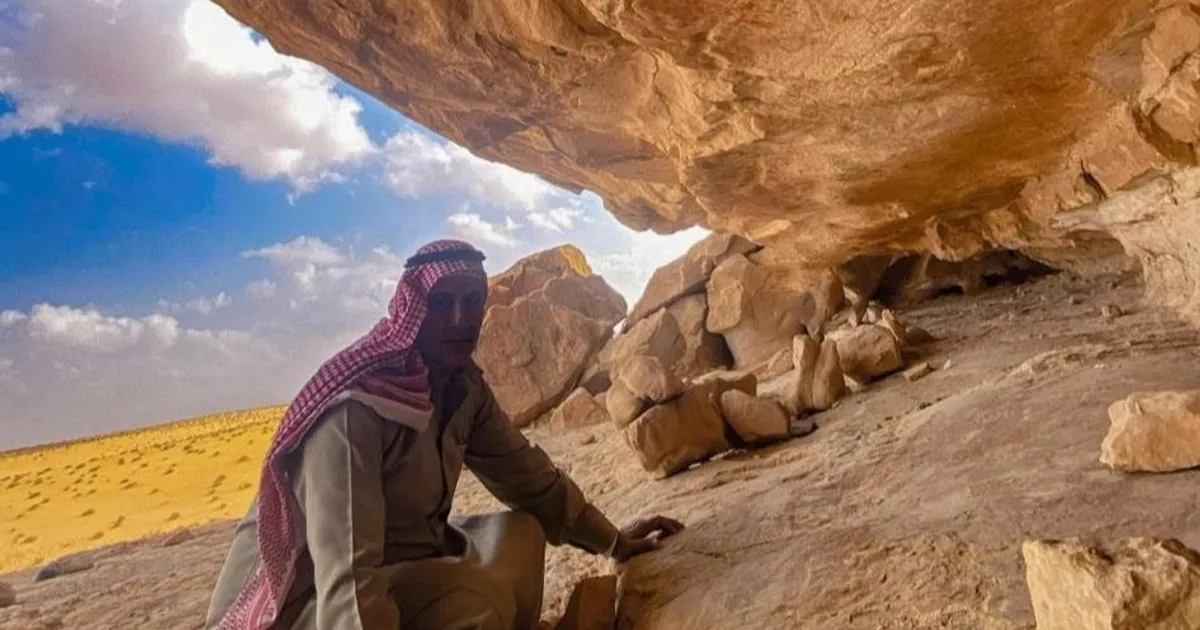
Saudi Arabia’s Heritage Commission has announced a landmark archaeological discovery at the Sahout site, located on the southern edge of the Nefud Desert between the Arnan and Al-Misma mountains in northern Arabia. The findings, published in the scientific journal Nature under the study title “The Natufian Epipalaeolithic and Pre-Pottery Neolithic in the desert of northern Arabia,” document human settlement at the site dating back approximately 13,500 years — placing it among the most significant archaeological finds on the Arabian Peninsula in recent years.
A Window Into Arabia’s Earliest Inhabitants
The Sahout site occupies a strategic geographic position that once linked internal desert environments with settlement networks stretching toward the Levant. During the late Ice Age and the early Holocene, this corridor would have served as a passage for human movement across a region that was, at the time, considerably more hospitable than it appears today. Stratified excavations at the site uncovered distinctive stone tools, most notably Helwan bladelets — small, finely crafted implements used as arrowheads or components of composite hunting tools.
These artifacts are considered key archaeological indicators of the Natufian culture, a late Stone Age people who inhabited parts of the Levant and, as this discovery confirms, reached as far as the northern Arabian desert. Their presence at Sahout demonstrates that early communities in this region possessed advanced technical skills and the ability to thrive in challenging desert environments, while maintaining cultural connections to civilisations further north.
Two Phases of Settlement and Long-Distance Networks
Excavations at the site documented not one but two distinct periods of human activity. The earlier phase, approximately 13,500 years ago, is associated with the Natufian presence and characterised by finely crafted Helwan bladelets. The later phase, dated between approximately 10,300 and 8,700 years ago, reflects a period of increased settlement density and further technological advancement in stone industries. Among the finds from this second phase were Abu Salem points — a finely crafted type of arrowhead associated with the Pre-Pottery Neolithic period.
One of the study’s most striking findings relates to the origin of the materials used to make these tools. Geochemical analyses of the obsidian recovered from the site traced the raw material to Jabal Al-Abyad in the Khaybar region, approximately 190 kilometres to the south. This confirms the existence of long-distance exchange networks between early Arabian communities and highlights a level of social organisation and mobility far more sophisticated than previously documented for this period in northern Arabia.
Rock Art and the Birth of Artistic Expression
The discoveries extend beyond stone tools. Researchers documented a direct link between the human occupation layers and rock art found at the Sahout site, including artistic elements depicting life-size camels and human figures. Carving tools were found within the same dated archaeological layers as the artworks, providing a rare chronological anchor for understanding when these images were created.
The Heritage Commission, operating under the Ministry of Culture, noted that these findings offer a precise timeline for the development of artistic expression in northern Arabia, confirming that visual culture was an integral part of community life during these formative periods. The discovery reaffirms the Kingdom’s ongoing commitment to cultural preservation and deepening the world’s understanding of the ancient human story inscribed across its landscape.