

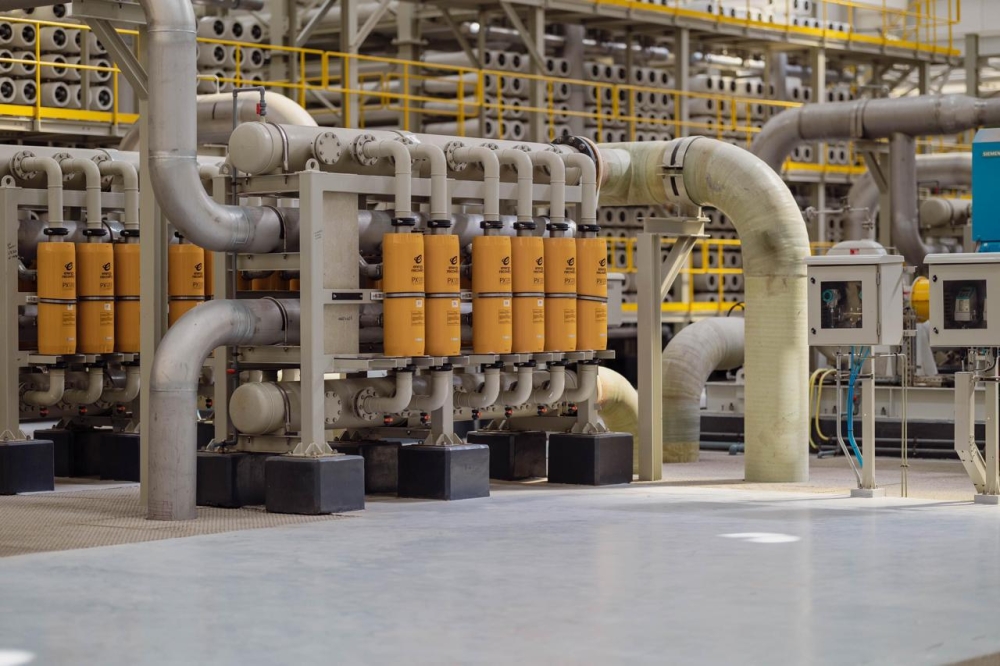
The Saudi Water Authority has announced that the Shuaiba-5 desalination facility on Saudi Arabia’s western coast has exceeded its designed output capacity by 11 percent, pushing daily water production from the original 600,000 cubic metres to 665,000 cubic metres — without any additional operational costs.
The achievement goes beyond volume. Shuaiba-5 has received official certification from Guinness World Records for the world’s lowest energy consumption in reverse osmosis desalination, running at just 1.7 kilowatt-hours per cubic metre. That figure represents a landmark in global water technology, placing Saudi Arabia at the frontier of sustainable desalination engineering.
A Record Built on National Expertise
The Saudi Water Authority credited national engineering talent for the efficiency gains, noting that the results reflect advances in how modern desalination systems are designed, constructed, and operated through domestically developed technical capabilities. The project also won the Asian Water Awards for 2025, recognised for achieving zero carbon emissions — a distinction that has redefined expectations for large-scale seawater desalination globally.
The World Bank has formally praised Shuaiba-5 as an advanced reference model for improving energy efficiency in desalination infrastructure, a recognition that elevates the project from a national milestone to an international benchmark. The authority noted that the improved output directly enhances supply dependability and optimises the return on infrastructure investment while maintaining the highest standards of energy efficiency and operational requirements.
Strategic Impact for Makkah and the Hajj Season
The operational improvements carry direct implications for millions of pilgrims and worshippers in the Makkah region. Shuaiba-5 plays a central role in securing water supply reliability during the Hajj and Umrah seasons, when demand surges substantially across the region. The performance gains ensure the system can meet rising consumption while maintaining energy efficiency standards and managing carbon output.
The Saudi Water Authority confirmed that the project’s carbon reduction impact exceeds two million tonnes annually, contributing to the Kingdom’s environmental targets under Vision 2030. The Shuaiba-5 results illustrate how Saudi Arabia is approaching water security and environmental sustainability not as competing priorities, but as a single integrated objective — delivering more water while emitting less carbon.
Leading the Global Desalination Sector
Saudi Arabia is already the world’s largest producer of desalinated water, with daily output equivalent in volume to global daily oil production. The Shuaiba-5 results strengthen that position and signal that the Kingdom’s leadership in this sector is being driven increasingly by technological innovation rather than scale alone. With the IDRA 2026 Global Desalination Congress set to take place in Riyadh, Saudi Arabia will host the world’s water technology community at a moment when its own achievements are setting the pace for the industry.