

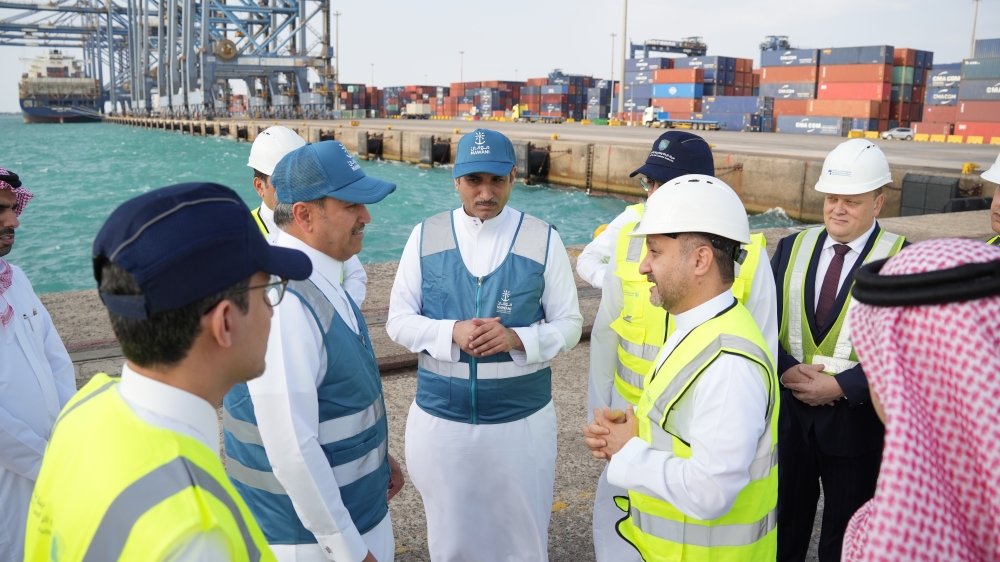
Saudi Arabia has launched a series of dedicated logistics corridors designed to receive containers and cargo diverted from ports in the Kingdom’s Eastern Province, as well as from ports across GCC countries, redirecting them to Jeddah Islamic Port and other Saudi ports along the Red Sea coast.
A Strategic Response to Regional Supply Chain Pressures
The initiative was announced by Saleh Al-Jasser, Minister of Transport and Logistics Services and Chairman of the Saudi Ports Authority (Mawani), in the presence of Suhail Abanmi, Governor of the Zakat, Tax and Customs Authority, and a number of senior government officials. Al-Jasser affirmed that the Kingdom’s transport and logistics infrastructure stands at a high level of operational readiness, with the capacity to respond swiftly to shifts in regional and global supply chain conditions.
He emphasized that the flexibility of Saudi logistics services and the strength of the Kingdom’s port network have allowed the country to activate alternative corridors rapidly, ensuring the continued and smooth flow of trade across the region. The minister noted that Saudi Arabia views this initiative as a natural extension of its established role in facilitating international commerce.
Strengthening Saudi Arabia’s Position as a Regional Logistics Hub
The corridors initiative is aimed at providing efficient, dedicated pathways for the handling and movement of diverted cargo, reducing bottlenecks and minimizing delays for importers and exporters dependent on regional port networks. Saudi Arabia’s ports on the Red Sea coast — led by Jeddah Islamic Port, the largest port in the country and one of the busiest in the Middle East — are well-positioned to absorb increased cargo volumes.
Jeddah Islamic Port has expanded significantly in recent years, with investments exceeding one billion Saudi riyals to upgrade its North Container Terminal through a partnership with the Red Sea Gateway Terminal. The port now has the capacity to handle vessels carrying up to 19,800 TEUs, placing it among the most capable facilities in the region. The Saudi Ports Authority has also been steadily developing integrated logistics parks within the port’s footprint, attracting global shipping companies and logistics operators.
Reinforcing Vision 2030 Logistics Ambitions
The launch of these logistics corridors reflects Saudi Arabia’s broader ambitions under Vision 2030 to position the Kingdom as a global logistics hub connecting Asia, Europe, and Africa. The National Transport and Logistics Strategy targets the establishment of integrated supply chain solutions that reduce dependency on any single corridor or transit route, giving the Kingdom strategic resilience in an era of shifting global trade patterns.
By activating these dedicated pathways, Saudi Arabia signals both the maturity of its infrastructure and its readiness to serve as the region’s preferred alternative when disruptions arise elsewhere. The move reinforces the Kingdom’s standing not only as a major producer and consumer market, but as a reliable and agile partner for international trade flows that run through one of the world’s most strategically positioned coastlines.