

Saudi Arabia is advancing its position as a future global exporter of green hydrogen, with its flagship NEOM Green Hydrogen Company (NGHC) building what is expected to become one of the world’s largest facilities of its kind along the Kingdom’s Red Sea coast. The project marks a significant milestone in Saudi Arabia’s clean energy ambitions and its bid to establish a leading role in the emerging global hydrogen economy.
The NEOM Green Hydrogen Plant
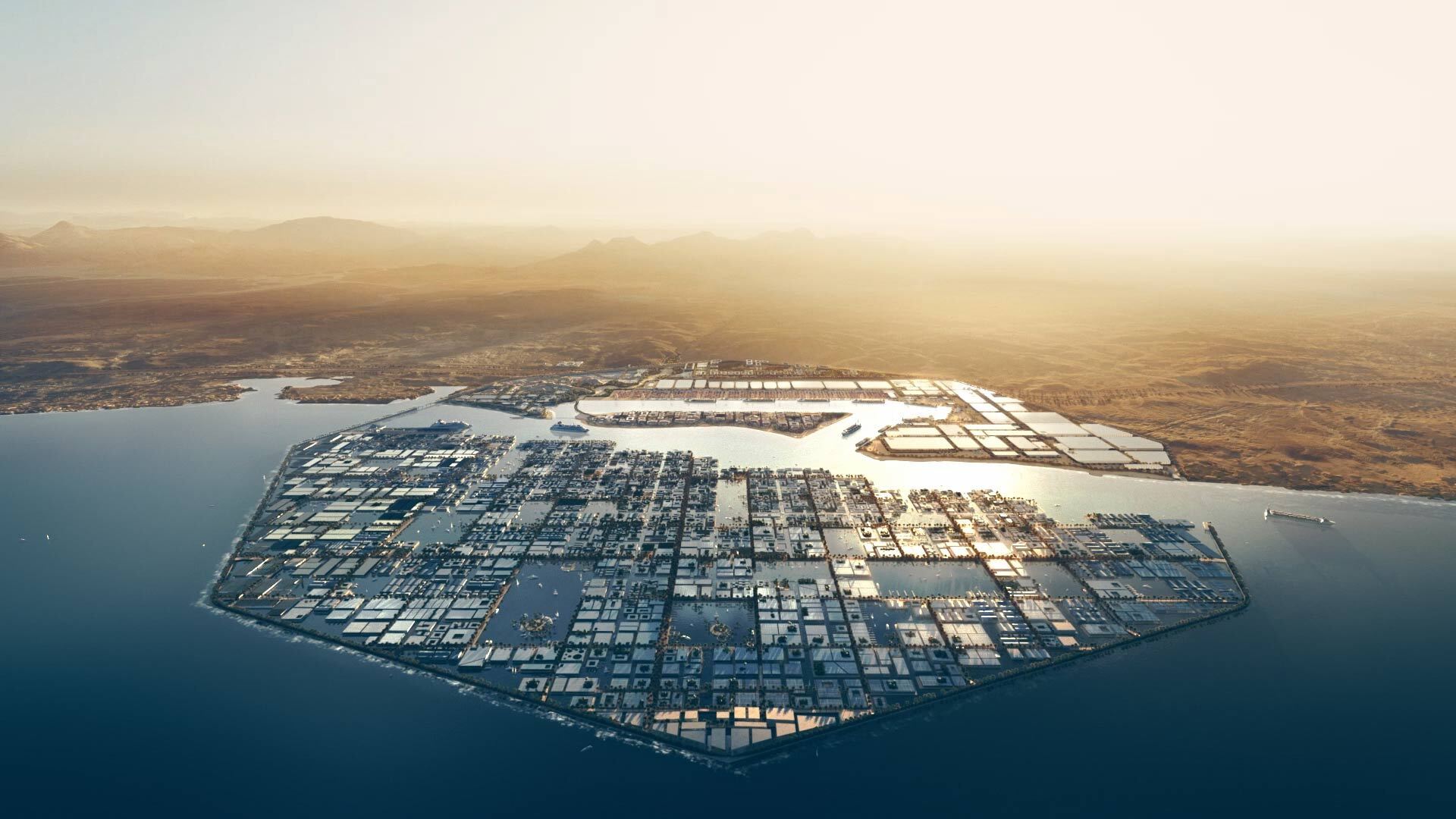
Located at Oxagon — the innovative industrial floating platform that forms part of the NEOM development zone — the NGHC facility will harness renewable energy generated by a combined 4 gigawatt system of solar and wind power. That renewable electricity will drive electrolysis, splitting water into hydrogen and oxygen without any carbon emissions. The hydrogen produced will then be converted into green ammonia, a more practical form for long-distance maritime shipping, before being exported to international markets.
The project’s commercial structure is built around certainty. A 30-year offtake agreement with Air Products — one of the world’s largest industrial gases companies — commits 100 percent of the facility’s output to the American firm, which will manage global marketing and distribution. Wesam Al-Ghamdi, CEO of NEOM Green Hydrogen Company, explained the significance of this arrangement: “NGHC’s green hydrogen output is fully committed under an exclusive 30-year offtake agreement with Air Products, which will take 100 percent of the production and export it to global markets in the form of green ammonia.”
The project’s 4 GW solar and wind power generation sites are expected to be completed by mid-2026, with commissioning of hydrogen production to follow as the facility moves toward full operation.
Ammonia as the Hydrogen Carrier
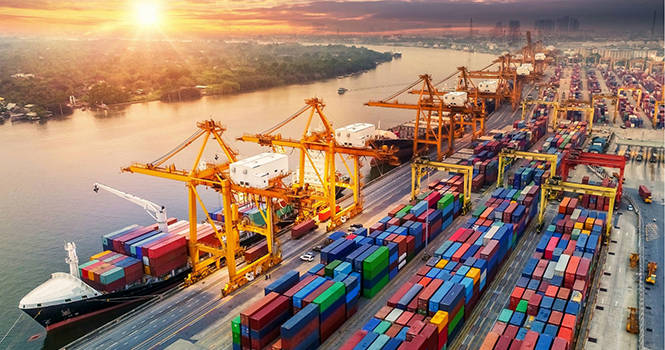
One of the fundamental challenges in green hydrogen is how to transport it economically across ocean distances. Hydrogen in its pure form is extremely low in density, making bulk shipping difficult and expensive. The NEOM project addresses this by converting hydrogen into ammonia before export — a proven technology that allows hydrogen to be shipped using established global practices.
Al-Ghamdi described ammonia as the optimal solution for Saudi Arabia’s export strategy: “Our project is designed to transport green hydrogen in the form of green ammonia, which is a highly dense, carbon-free hydrogen carrier that is easier to transport and store than hydrogen. This choice reflects both technical and logistical considerations at scale, particularly for long-distance maritime transport.” Once imported by the receiving country, the ammonia can be converted back to hydrogen or used directly as a clean fuel in industrial and power applications.
Green Hydrogen and the Energy Transition
Hydrogen is increasingly recognised by governments and industries as a critical tool for decarbonising sectors that cannot easily be electrified — including steel manufacturing, chemical production, fertiliser synthesis, heavy shipping, and certain forms of power generation. Saudi Arabia’s entry into large-scale green hydrogen production positions the Kingdom to supply precisely the growing markets that are developing fastest: those with established climate policies and infrastructure capable of supporting hydrogen or ammonia imports.
The NEOM green hydrogen project is also a strategic signal about the direction of Saudi Arabia’s energy economy. For decades, the Kingdom has led the world in oil exports; the development of a credible, large-scale green hydrogen export platform represents an intentional expansion of that energy leadership into the post-carbon era — with the same fundamentals that have made Saudi Arabia a pivotal energy supplier: scale, infrastructure investment, and long-term commercial commitment.