

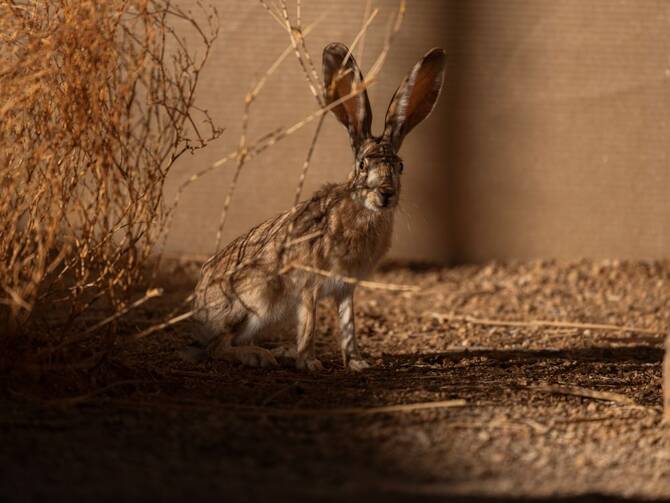
The Prince Mohammed bin Salman Royal Reserve has welcomed a new resident to its sprawling desert landscape. The Arabian hare, known scientifically as Lepus capensis arabicus, has been reintroduced as the 14th native species to return under the ReWild Arabia program, which began in the winter of 2022.
A Keystone Species for Desert Ecosystems
The Arabian hare occupies a critical position in the desert food web. As a primary consumer, it serves as a bridge between vegetation and predators, transferring energy upward through the trophic pyramid. Its grazing habits help regulate plant growth across the reserve’s varied terrain, while its role as a principal prey species sustains populations of jackals, foxes, wildcats, and hyenas.
Reserve CEO Andrew Zaloumis emphasized the significance of the reintroduction. “True rewilding restores processes, not just populations,” Zaloumis said. “By bringing back the Arabian hare, we strengthen the connections that allow desert life to recover and flourish.”
Built for the Desert
Unlike many desert mammals that seek shelter underground, the Arabian hare thrives entirely on the surface. Its cryptic coloration blends seamlessly with the arid landscape, offering natural camouflage against predators. Its oversized ears, measuring up to 17 centimeters and accounting for roughly 30 percent of its body length, function as efficient cooling systems and provide acute directional hearing.
When pursued, the hare can reach speeds of 80 kilometers per hour, executing sharp zigzag maneuvers to evade capture. Despite these remarkable adaptations, predation rates in desert environments can reach as high as 90 percent, underscoring its foundational importance in sustaining predator populations.
Growing Numbers and a Broader Vision
Twenty Arabian hares were carefully selected to maximize genetic diversity and placed in purpose-built breeding enclosures. The first leveret has already been born, marking an early success for the initiative. These individuals will eventually be released into the wild to supplement the reserve’s existing population.
Since the ReWild Arabia program launched, the reserve has recorded more than 100 sand gazelle births, 19 mountain gazelle births, 36 Arabian oryx calves, the first Nubian ibex kids, and a Persian onager foal. The ultimate goal is to reintroduce 23 historically native species, including the Arabian leopard and cheetah.
Spanning 24,500 square kilometers from volcanic lava plains to the Red Sea coast, the Prince Mohammed bin Salman Royal Reserve covers just one percent of Saudi Arabia’s land area yet hosts more than half of the Kingdom’s species. The program operates under the supervision of the Royal Reserves Council and contributes directly to Vision 2030 and the Saudi Green Initiative, which aim to protect 30 percent of the Kingdom’s land and sea by 2030.