

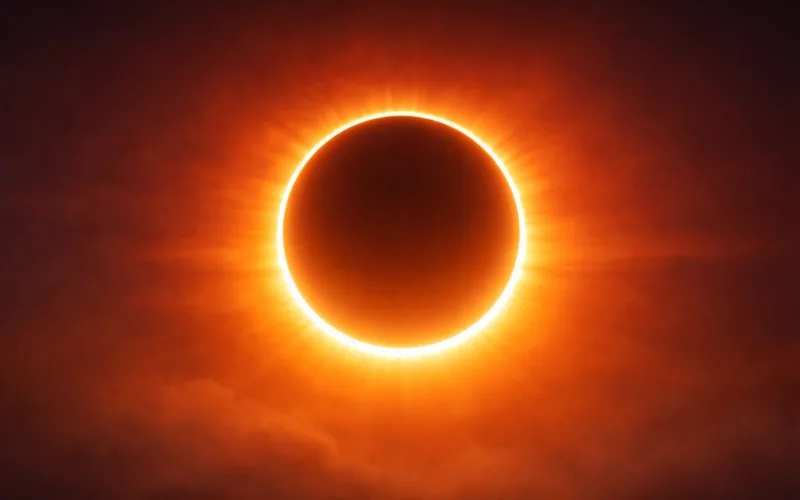
The solar eclipse Ramadan 2026 event will directly influence the timing of the holy month as Saudi Arabia prepares for this rare celestial occurrence. Moreover, an annular solar eclipse, known as the “ring of fire,” is set for Tuesday, February 17, 2026, coinciding with crescent-sighting day for Ramadan 1447 AH.
Solar Eclipse Ramadan 2026: Astronomical Challenges
Astronomers have confirmed that this solar eclipse Ramadan 2026 makes it impossible to sight the Ramadan crescent on February 17. Furthermore, the moon will remain in conjunction with the sun during the critical observation window.
The moon will be positioned less than half a degree from the solar disk as viewed from Makkah. Additionally, this means the crescent will set with the sun, leaving no visible trace in the evening sky.
Regional Eclipse Visibility and Effects
The annular eclipse will be visible from southern Africa and Antarctica during this solar eclipse Ramadan 2026 event. However, its effects will extend across much of the eastern hemisphere, affecting crescent visibility globally.
In Riyadh, calculations show the eclipse will conclude approximately 25 minutes before sunset. Moreover, the moon’s elongation angle will not exceed one degree — far below the six-degree threshold required for sunlight reflection.
Expert Astronomical Analysis
Saudi astronomer Abdullah Al-Khudairi highlights the exceptional challenges facing crescent observers during this solar eclipse Ramadan 2026. Furthermore, Venus’s proximity to the moon’s expected position could create confusion among observers.
Al-Khudairi emphasized that less experienced observers may mistake the planet for the crescent. Additionally, he noted the crescent being sought will be virtually adjacent to the sun, not elsewhere in the sky.
Advanced Technology Deployment
The Tamir Observatory in Saudi Arabia is deploying advanced digital telescopes for this solar eclipse Ramadan 2026 observation. Moreover, specialized light-filtering technology will handle the unusual atmospheric conditions.
Observatory teams will analyze multiple factors including moon’s elevation angle above horizon at sunset. Furthermore, they’ll measure angular distance between sun and moon centers, plus humidity levels affecting light refraction.
Ramadan 2026 Timeline Determination
Based on these astronomical determinations from the solar eclipse Ramadan 2026 analysis, Ramadan’s first day is expected Thursday, February 19, 2026. However, this applies across Saudi Arabia and most of the Muslim world.
Eid Al-Fitr is projected for Friday, March 20, 2026. Additionally, this timeline follows precise scientific methodology for Islamic calendar date determination.
Scientific and Religious Integration
The convergence of this solar eclipse Ramadan 2026 represents a scientifically significant moment. Therefore, it underscores Saudi Arabia’s growing investment in astronomical infrastructure and research institutions.
The Kingdom’s observatories continue playing leading roles in applying precise scientific methodology to Islamic calendar dates. Furthermore, this bridges traditional religious practice with cutting-edge technology in service of the faith.
This solar eclipse Ramadan 2026 event demonstrates how modern astronomical science enhances traditional Islamic lunar calendar observations through advanced technology and expert analysis.